

Probably the title of this piece surprised you, or made you turn up your nose, or intrigued you.
“What do you mean? There’s no “review”? Not even an “opinion”? A summary? A translation of an article? Something like “I went to the movies and tell you what I think of this film”?
Nothing?”
That’s right. None of the above.
The reason is simple. Past Lives, Korean director Celine Song’s highly acclaimed film starring Greta Lee and Teo Yoo, that won many awards and is also up for a few Oscars, did not appeal to me. I didn’t like it.
I found it dull and superficial, with a predictable plot and lacking the – necessary, in such cases – balance with reflective elements (Ordinary days docet, in this regard), or artistic ones (photography, outstanding acting performances, dialogues, … ). On the other hand, taste in such matters is subjective, so I take note that I am part of a very small group of detractors and I’m good with it
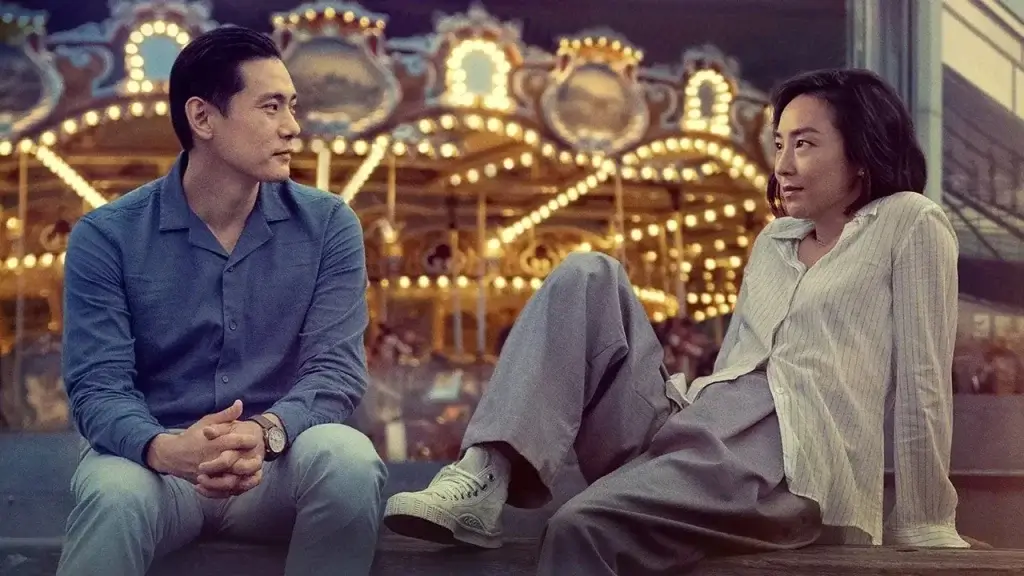
One thing remained, though. The concept, the spark, the narrative device around which the story of Nora and Hae Sung-children in love, more like two strangers now – moves: Inyeon, or to paraphrase it, the philosophy of how relationships are formed through past lives. And that’s what I want to talk to you about.
Maybe it is because in my life I have, even in recent years, felt that kind of inexplicable connection with people I just met, distant and different, “as if we had known each other forever“. Or maybe it is the fact that I am so always hungry for elements that can help me understand the complex and multifaceted modern Korean society; besides, this concept also brings to mind a lot of K-dramas we have seen even recently, A good day to be a dog – to name one.
When I came back from the cinema, I couldn’t help but sit down in front of my PC and start looking around to better understand the roots of this fascinatingly metaphysical abstraction.
Inyeon (인연) is a Korean term meaning “intertwined fate” or “causal relationship”; its purpose is to give form and explanation to that complex dance of fate that intertwines the lives of individuals in a kind of karmic harmony. It represents one of the pillars of Korean Buddhism and offers a unique lens through which to understand relationships, individual responsibility, and the interconnected nature of existence.
We could translate it as “fate,” or “destiny,” but that would be limiting. The philosophical roots of inyeon lie in the concepts of Karma, a cardinal principle of Buddhism that establishes a chain of cause and effect between an individual’s actions and his or her future, and Sunyata, a Buddhist philosophy that holds that all phenomena are interconnected and lack independent existence.
Inyeon therefore is rooted in the assertion that our relationships and interactions with others are the result of our past karma. In other words, the people we meet and the experiences we have are not random, but the result of a karmic path that unravels through time; moreover, it reflects the interconnectedness of all phenomena, showing how our lives are linked to those of countless other beings in a web of relationships that extends far beyond our immediate reality.
For those who believe, inyeon permeates all kinds of relationships, from the most intimate such as family and romantic ones to the most distant, with those of friends and even strangers. Each encounter takes on deep meaning, becoming an opportunity for growth and mutual evolution. Inyeon awareness leads us to be grateful for the positive people who enrich our lives. At the same time, it teaches us to welcome challenges and difficult relationships as opportunities for growth and karma purification.
It also urges us to develop a deep sense of compassion for others through striving to understand their actions, positive or negative, which are nothing but the result of their past karma. In this way, compassion becomes an antidote to judgment and a bridge to universal understanding and love.
In Korean society, this philosophical concept has had a very significant impact, mixing with Confucian principles of harmony and respect for relationships. The emphasis on interconnectedness and karmic responsibility has helped shape Korean society’s strong emphasis on family and collective well-being. Inyeon reinforced the importance of family in Korean society, with an emphasis on the influence of collective karma and everyone’s responsibility to cultivate positive relationships within the household. Bonds within the family are seen as sacred, and respect for parents and elders is considered a core value. The concept implies loyalty and obligation to family members: children are expected to care for their elderly parents and sacrifice their own needs for the good of the family. Ancestor veneration, which as we know is a widespread practice in Korea, stems from the belief that ancestors influence the fate of their descendants. Inyeon reinforces this belief by encouraging respect and gratitude toward past generations.
The emphasis on interconnectedness and karmic responsibility has helped shape Korean society’s strong emphasis on social harmony and group cohesion. In addition, this belief emphasizes the interdependence of all living beings and the responsibility that each has toward the collective well-being. This sense of reciprocity encourages cooperation and mutual aid within the community, fostering the development of volunteerism and charity, among other things.
Past Lives explores inyeon through the relationship between Nora (or Na-Young, as she was known in Korea before she left for Canada, where she grew up) and Hae-sung, her childhood friend and first crush. The narrative moves over a timeline spanning more than two decades, and is based on “twists and turns,” “sliding doors,” choices and reflections that lead two people to question whether they are meant to be together. In the film, the introduction of the concept of inyeon gives the characters a way to explore the possibilities of coming together not only in this life, but possibly-if not yet “mature” on a karmic level in the now-in subsequent lives, as well as wondering what brought them together in previous lives.
However, in my online research, I have realized that inyeon is not a concept that is referred to much anymore in Korean popular culture: it originated at a time when traditional religious beliefs were a more common feature of the daily social life of Koreans.
We can say it has been supplanted by the more modern concept of “jeong,” the idea of “us-ism” or “unity,”, “one heart-one mind”. That unsolicited acts of kindness, the so-called “invisible hugs”. Jeong is when someone leaves you the sit on the bus without being asked to, a free extra side dish with the bulgogi you ordered, a lost wallet handed to the police, someone helping you out of the subway (I speak from personal experience),…
In the movie, the main character offers the international viewer a clue as to why inyeon is not known as jeong outside of Korea when she explains, “It’s just something Koreans say to seduce someone”, suggesting that nowadays it is used more often in intimate or sentimental situations rather than in other contexts.
However, as we have seen, inyeon has deeper roots than Nora’s disenchanted comment suggests. To conclude, we could say that both inyeon and jeong describe aspects of “we” as an inextricable and causal relational bond, where inyeon is a cause and jeong an effect.