


Returning to the place where he learned to speak to find his true voice. This is the path chosen by BamBam, who, after conquering the international charts first with GOT7 and then as a soloist, does something profoundly counter-current: he returns home.
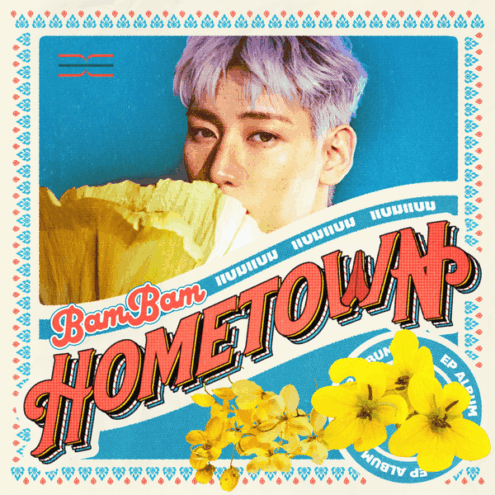
His new EP, HOMETOWN, is a project sung entirely in his mother tongue, Thai. In an era where the expansion of K-pop seems to know no boundaries, his appears as a radical decision. A way to tell his first audience “I am still one of you” and, perhaps, to indicate a new way: no longer just exporting a model, but showing the world the cultural richness from which he comes, laying the foundations for the next global trend.
The long journey from idol to artist
Born in Bangkok as Kunpimook Bhuwakul, BamBam honed his craft amidst the lights and rules of the Korean industry. Joining JYP Entertainment at a young age, he debuted in 2014 as a member of GOT7, a group that in just a few years would redefine the very idea of the cosmopolitan idol. Following the group’s departure from their label in 2021, each member embarked on a solo path, and for BamBam, it marked the beginning of a surprisingly consistent phase of artistic exploration.
His first solo EP, riBBon (2021), was an explosion of color and lightness, almost a liberating act after years of discipline and group work. With B (2022) and Sour & Sweet (2023), he then pivoted to a more introspective tone, exploring the loneliness, authenticity, and vulnerability of an artist balanced between two worlds. In an interview with Rolling Stone Korea, BamBam confessed:
For a long time, I tried to figure out who I was when I wasn’t on stage. Now I know the answer is simple: I am someone from Bangkok.
HOMETOWN, released this past October 10th, represents the culmination of this search, the point where everything converges: the technique learned in Korea, the sensitivity developed over time, and the language that brings him back to his first truth.

HOMETOWN, A Declaration of Love
HOMETOWN is BamBam’s first album entirely in the Thai language—and, more broadly, a celebration of his connection to his roots. The artist was directly involved in the writing and composition of every track, further establishing himself as a complete musician capable of building cohesive and personal soundscapes.
The album was born from a desire to share the sound of his own language and the rhythm of his roots with the world. For BamBam, singing in Thai is a gesture that moves beyond nostalgia to open a door, inviting listeners into an intimate dimension where music becomes both a universal language and an identity.
This dialogue between past and present features three exceptional voices from the Thai music scene—TIMETHAI, Jeff Satur, and INK WARUNTORN—each representing a fragment of the vibrant landscape that is redefining the country’s pop culture. And then there is Pharrell Williams, who produced the final track, Angel in Disguise. His presence is not meant to Westernize the record but rather to solidify its global reach, as if BamBam wanted to bring the circle full, connecting the boy from Bangkok with the artist performing for the world.
On September 13th, BamBam brought Angel in Disguise to the stage at Grace for the World, the Vatican’s first public concert in over two thousand years—an event of historical significance that we covered in a dedicated article here on Koreami. In that unique setting, his performance took on the value of a secular rite, where the universal language of music merged with the act of returning home.
As he told Billboard Thailand:
Writing in Thai allowed me to sing without translating what I feel. It was like speaking with my heart again.
And indeed, everything in HOMETOWN revolves around this: the freedom of unfiltered expression, the joy of recognizing one’s own voice in its most authentic form.
HOMETOWN Five Faces
HOMETOWN opens with Dancing By Myself (feat. TIMETHAI), a track that combines sophisticated rhythms with an elegant melancholy. It is a song about isolation and desire, yet with the lightness of someone who knows that loneliness can also be a form of freedom. The music video, set on a rooftop overlooking the lights of Bangkok, perfectly embodies the urban and cinematic dimension that BamBam associates with his idea of “home.”
The collaboration with TIMETHAI, an established artist on the Thai T-Pop scene, is a choice that anchors the track to BamBam’s roots. His presence creates an authentic bridge between the artist’s global star status and the culture of his home country. The two merge their respective styles in an energetic performance that enhances the song’s message of independence, enriching it with the dynamism typical of contemporary Thai music.
Next is More Than Friend (feat. Jeff Satur), one of the most significant collaborations on the EP. Satur, one of the most refined faces of the new Thai pop scene, is a complete artist—a singer-songwriter, producer, and actor—who moves effortlessly between R&B, synth-pop, and cinematic ballads. Their collaboration creates a dialogue where their voices don’t just overlap but seem to search for one another: BamBam’s direct brightness finds a unique resonance in Satur’s melancholy and velvety voice. The track explores that fragile balance between friendship and desire, where sincerity coexists with the fear of going further. It is a moment of emotional suspension that embodies one of the album’s most universal themes—love as a form of mutual recognition, but also as a risk.
Wondering is the heart of the EP, the main track: an intimate and suspended ballad where BamBam’s voice becomes a tool for introspection. It is the song of someone observing their own life from a distance, wondering what it truly means to “belong.” Here, the balance BamBam has learned to master is on full display: the production is modern and flawless, yet it is governed by a nostalgic tenderness that feels like his truest signature. You can find the lyrics and translation for Wondering at this link.
With Greenlight (feat. INK WARUNTORN), the album takes a brighter turn: it’s an anthem to possibility, an opening to hope. The track plays with urban imagery and ’80s synth sounds, as if after traveling the roads of the past, BamBam can finally pass through a green light and move forward.
The collaboration with INK WARUNTORN, one of the most beloved voices in Thai synth-pop, introduces a dreamy and optimistic dimension. An award-winning artist recognized throughout Asia, INK WARUNTORN is known for her glittering melodies and a style that evokes the sounds of the ’80s, perfectly aligning with the song’s atmosphere. Her sweet yet melancholic vocal tone marries the track created by BamBam, giving life to a duet that amplifies the theme of hope and of letting go into the future.

The album closes with Angel in Disguise (prod. by Pharrell Williams), which, with its ethereal and almost spiritual touch, serves as a suspended conclusion. It is a song about faith—not in a religious sense, but a human one. Faith in the journey, in memory, and in the beauty that is born from acknowledging one’s fragility. Pharrell’s contribution amplifies the record’s cosmopolitan dimension, lending the sound an international scope without betraying its Thai essence.
Each track on HOMETOWN marks a stop on an emotional map: from loneliness to desire, from doubt to gratitude. It is not a journey into the future, but to the point where past and present overlap, becoming a single voice.
Finding a home within one’s own voice
Through this new work, BamBam solidifies his position as one of the most interesting artists in the new post-idol scene, capable of blending authenticity and ambition. His choice to sing in Thai, however, transcends a personal statement, transforming into a potential launchpad for T-pop on a global scale. Leveraging his international visibility, BamBam acts as a pioneer, using HOMETOWN as a bridge to introduce the richness of the Thai music scene to a new audience. The album thus becomes the catalyst for a possible new artistic wave, a “green light” for Thai culture on the world stage.
With HOMETOWN, then, the circle doesn’t close. It expands. It is as if BamBam, after exploring the world, has taken the sound of his Bangkok and finally presented it not just as a personal horizon, but as a cultural destination for everyone. For him, returning home does not mean stopping, but remembering where every journey begins—and, in this case, where an entire new current can start. And to continue singing it, in the language that feels most like him, with the awareness of someone who has learned that for success to have meaning, it must feel like home.