

Back in 2009, in Asia, Girls’ Generation were everywhere with Gee and BIGBANG were filling arenas. In the West, however, South Korea was still quite literally another world, far from the mass phenomenon it is today. There were no TikTok algorithms to dictate trends, no k-drama on Netflix (how did we even live back then?)
At the time, Hyunwoo Sun was simply a young man with a passion for breakdancing, video-making, and foreign languages. Frustrated by a Korean school system that had taught him English to pass tests but not to speak it in real life, he decided hic et nunc to create the alternative that didn’t exist: a method for learning Korean in a natural and conversational way. That is how Talk To Me In Korean (also known as TTMIK) was born, 17 years ago.
Today, with over a million textbooks sold and a community spanning the globe, the project has become a pillar for anyone approaching Korean culture. Yet, among the labels of entrepreneur, author, or web pioneer, Sun chooses for himself that of “learner.” It is not, he tells us, a rhetorical pose: to get back in the game and experience firsthand the struggle of a student, he recently began studying Italian. This led to the launch of Corea Dentro: la cultura della Corea raccontata da un coreano, a podcast recorded entirely in our language where he discusses Korean culture while testing himself against Italian declensions and subjunctives.
Starting from scratch has certainly helped him better understand his students’ frustrations, but it has also allowed him to closely observe two almost opposite worlds. From the management of relational space to the frenzy of the Korean palli-palli contrasted with Italian rhythms, Hyunwoo tells us how language learning remains the cultural bridge par excellence. A conversation on what it means to defend the slowness of a physical book in the era of short-form video, and why, despite the advancement of artificial intelligence, the human factor remains the only thing that truly matters.
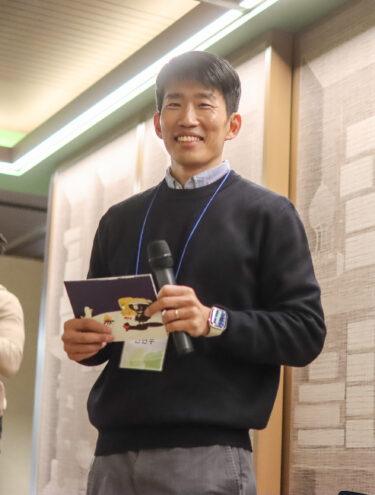
Koreami: How would you describe yourself today? Between being an entrepreneur, a content creator, an author, and now a podcaster in Italian, which role do you feel represents you the most in this current chapter of your life?
Today, more than anything, I see myself as a learner who also enjoys helping other people learn. My area of expertise just happens to be the Korean language, but the role that connects everything I do is that of a learner. Over the years, I’ve learned to speak several other languages. I’ve learned to breakdance. I’ve learned how to create language learning materials, and I’ve learned how to run a company. So if I had to describe myself in this current chapter of my life, I would simply say that I am a learner.
Who was Hyunwoo Sun before 2009? What was your path, and what specific limitation in the traditional education system convinced you to build an alternative from scratch?
Before 2009, I was just a Korean guy who loved learning languages, breakdancing, and making videos. I wasn’t planning to start a business. I was simply curious about learning and creating things.
The inspiration for Talk To Me In Korean came from two frustrations. One was the language education system I experienced in Korea. I had studied English for many years in school, but it didn’t really prepare me to use the language naturally. The other was the lack of good self-study materials for Korean learners at the time. I remember thinking that somebody should create better resources. And since no one was doing it the way I envisioned, I decided to start from scratch.
Koreami: When you founded Talk To Me In Korean, k-pop and k-dramas weren’t the global giants they are today. What was the spark that made you realize there was a global audience ready to learn Korean in a conversational, non-academic way?
In a way, I’m glad that we started before K-pop and K-dramas became global phenomena. It meant that our motivation was very simple and sincere. I wasn’t trying to ride a trend. I just genuinely wanted to help people learn Korean in a more natural, conversational way.
Even back then, there were already many people who wanted to learn Korean. Millions of people were visiting Korea every year, and many of them wanted to connect more deeply with the people and the culture. I could see that the interest was there, even if it wasn’t as visible as it is today.
And personally, I already knew how special the language and culture were. I believed that if people were given better, more accessible ways to learn Korean, they would naturally fall in love with it.
Koreami: Your podcast in Italian has been a fantastic surprise for many. What pushed you to launch a project specifically in our language, and how does your current role as an Italian “student” influence the way you teach Korean? But most of all… why Italian?
Starting to learn Italian became a wonderful new source of motivation for me. I’ve been teaching for a long time, and becoming a student again reminded me of how challenging and meaningful the learning process really is. It helped me better understand what learners need, not just in theory, but emotionally and practically.
Launching the podcast was my way of pushing myself further. It gave me a reason to actively use Italian, while also sharing stories about Korean language and culture at the same time. I liked the idea that I could grow as a learner and a teacher simultaneously.
And why Italian? In some ways, there wasn’t a single strategic reason. I simply fell in love with the sound of the language and the culture behind it. Sometimes that kind of personal curiosity is the best starting point.
Koreami: In your Italian podcast, do you pick topics specifically for the Italian audience based on certain criteria (like cultural similarities or specific curiosities), or do you simply follow your personal passions?
I already have a long list of topics I want to talk about, more than thirty, actually. So in many ways, the podcast is driven by my personal curiosity and the cultural themes I find meaningful.
I don’t always choose topics specifically for the Italian audience from the beginning. But as I write each script, I naturally find myself comparing Korean culture with Italian culture, looking for similarities and differences.
Koreami: Through your dialogue with Italian listeners, have you found any unexpected common ground or sharp contrasts between our culture and the Korean one?
One common ground that I find very interesting is how both cultures value emotional nuance. In both Korean and Italian, there are so many expressions that capture subtle feelings and sentiments. I think that reflects how important human relationships are in both cultures.
At the same time, one of the biggest contrasts is the relationship with time. In Korea, everything moves very fast, and people are almost always busy. In Italy, there seems to be more space to slow down and enjoy the moment. People take their time with meals, and deep conversations happen more naturally in everyday settings.
In Korea, deeper conversations often come later in the evening, sometimes with the help of soju, or during special occasions. That difference in rhythm has been very fascinating for me to observe as a learner.
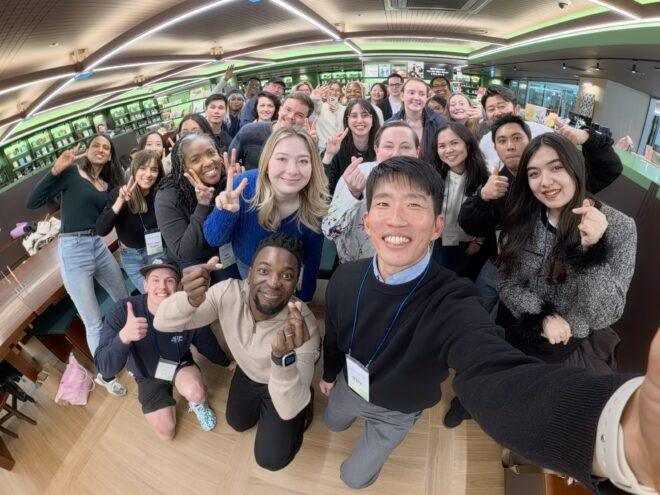
Koreami: What has been the toughest entrepreneurial challenge in growing TTMIK while maintaining the friendly, personal touch that your students love?
The biggest challenge was that, in the beginning, there was no one we could really benchmark. We were one of the first to offer online Korean learning resources for a global audience, so there was no clear model to follow. We had to learn how to run a business while, at the same time, continuing to teach and create meaningful learning experiences. Balancing growth with that personal, friendly touch wasn’t something we could learn from a textbook. We had to figure it out step by step.
Looking back, I’m very grateful that we’ve been able to continue doing this for so many years without losing that original spirit.
Koreami: You were pioneers in turning an online community into a physical publishing house. How strategic is the “physical book” in your ecosystem today, and how do you balance education with entertainment?
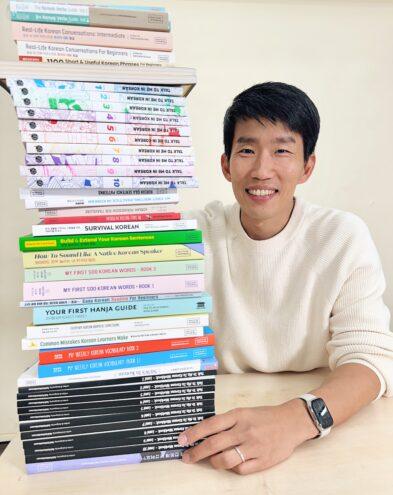
So far, more than one million Talk To Me In Korean books have been sold around the world, and I’m incredibly grateful for that. It’s always moving to imagine our books sitting on the desks and bookshelves of learners in so many different countries.
For me, a physical book represents a certain level of commitment. Of course, many people now learn through our digital courses and apps, but books still play a very important role because they align with the identity of being a dedicated learner. Even in my own case, while learning Italian, I’ve bought many physical books myself. There’s something meaningful about having that tangible companion in your learning journey.
As for balancing education and entertainment, especially on platforms like YouTube, we understand that engagement is important. So we try to incorporate elements of entertainment to make learning enjoyable. But at the core, education is always the main purpose. Entertainment is there to support the learning, not replace it.
Koreami: Compared to 10 years ago, have you noticed a shift in the type of students joining TTMIK? Do people who start for k-pop usually stay for deeper reasons?
Yes, very much. Ten years ago, many learners discovered Korean almost by accident, or they were learning it mainly for practical reasons, such as travel or personal connections. Today, Korean culture is much more visible globally, so many people start because of K-pop or K-dramas. That initial interest often becomes the gateway.
But what I’ve found is that many of them don’t stop there. As they continue, they naturally become more curious about the language and the culture behind what they enjoy. Language and culture are inseparable. And interestingly, those who begin to understand the language often develop a deeper, longer-lasting relationship with the culture itself.
Koreami: How has the brand evolved to stay relevant in the era of TikTok and short-form video, while still maintaining the depth required for language learning?
Short-form content is very powerful for inspiring people and helping them discover us for the first time. It can spark curiosity in just a few seconds. But it can never replace depth. Real progress in language learning requires sustained effort and deeper engagement. Short videos can create interest, but longer lessons are what help learners build real skills over time. At the same time, we try to bring as much substance and depth as possible even into our short-form content.
Koreami: Do you feel that learning Korean today also means adopting a new worldview? To what extent has TTMIK built cultural bridges beyond just linguistic ones?
Whenever you learn a new language, you also learn new concepts and new ways of expressing ideas. Naturally, you begin to see the world through a slightly different lens. It changes your perspective. I feel this very strongly myself while learning Italian. It has definitely widened my worldview. And I believe the same is true for people learning Korean.
Many learners have told us that learning Korean has changed the way they communicate and understand others. So even when our primary goal is to teach the language, we are also, in a natural way, helping to build cultural bridges.
Koreami: Between AI and algorithms, where do you see TTMIK in five years? Will the human teacher remain central, or are we moving toward fully automated personalization?
AI is already transforming language learning in dramatic ways. Learners can now practice anytime and anywhere, and that’s why we’ve been actively developing apps and digital tools to support that kind of flexibility.
But I believe human teachers will remain essential. AI can provide practice, feedback, and personalization, but teachers give direction, meaning, and cultural context. They help learners understand not just how to use the language, but why it matters. In the end, the goal of language learning is not just efficiency. It’s about having new experiences, broadening your perspective, and connecting with other people. And in that process, the human role will always be central.
Talk To Me In Korean
Explore the world’s leading platform for learning the Korean language, founded by Hyunwoo Sun. You will find interactive courses, videos, and the renowned series of physical textbooks.
VISIT THE OFFICIAL WEBSITE →