

The Republic of Korea currently stands at the center of a structural transformation that is redefining the very concepts of national identity and economic participation. What was considered a closed, homogeneous society for decades is now undergoing an accelerated metamorphosis, driven by an unprecedented demographic crisis. With a fertility rate that hit an all-time low of 0.72 in 2023 and projections of 0.75 for 2024, the nation has officially entered what analysts call a “demographic winter.”
This contraction of the domestic workforce has forced the Seoul government and major industrial conglomerates to radically reconsider the role of international talent. In 2025, the number of foreign residents reached a historic record of 2.72 million, representing 5.2% of the total population—a milestone that marks Korea’s transition into a multicultural society.
The Demographic Winter and Economic Shift
The current South Korean macroeconomic context is characterized by a fundamental paradox: while the economy continues to show extraordinary resilience—with exports exceeding $700 billion thanks to the boom in semiconductors and AI—the demographic foundations of the system are beginning to crack. The working-age population (15-64 years) has decreased sharply, falling from 36.64 million in 2020 to 35.62 million in 2024.
This human capital deficit is no longer limited to the 3D (Dirty, Dangerous, Difficult) manufacturing sectors; it has extended to high-tech industries, where a shortage of at least 580,000 qualified professionals is expected by 2029.
In response, the government launched the Study Korea 3.0 initiative, aiming to attract 300,000 international students by 2027—a target reached two years ahead of schedule in August 2025. However, attracting talent is only half the battle; integration into the professional labor market remains the primary hurdle. Although 86% of international students express a desire to stay and work in Korea after graduation, transitioning to a specialized work visa like the E-7 remains extremely difficult.
Monica Jung: Decoding the HR Code in Seoul
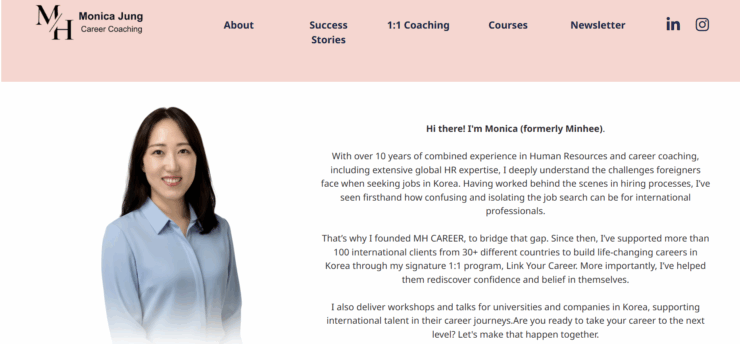
Monica Jung (formerly known as Minhee) is the founder of MH Career and a specialist in career strategies for international professionals. Her expertise is not purely academic; she operated “behind the scenes” of HR departments in global contexts for over a decade. Her mission is not simply to facilitate finding “any job,” but to bridge the gap between ideal aspirations and strategic execution in East Asia’s most competitive job market.
Jung’s methodology, realized through the Link Your Career (LYC) program, departs radically from traditional mass-application approaches. Her approach recognizes that for a European, success in Korea depends not just on hard skills, but on the ability to position oneself as a strategic solution to a specific business problem.
The Interview: Key Access Points to the Korean Dream
Your mission is to help professionals “build dream careers in Korea.” Many of our Italian readers have this dream, often idealized. What is the biggest gap between the dream of working in Seoul and the reality of the job market they face?
The biggest gap lies between the roles or companies candidates want to work for and the roles they can realistically access in the Korean job market. Many international job seekers assume they can pursue the same roles they held in their home countries, or that they can enter their preferred industries in Korea, such as entertainment. However, in many cases, a strong profile in one’s home country does not automatically translate into success in the Korean job market. The key issue is that some roles or industries simply do not require foreign hires to the extent candidates expect. As a result, even strong candidates may find that the opportunities they are targeting are far more limited than anticipated.
Let’s address the most common question: Korean fluency. How honest can we be? In 2025/2026, is it realistically possible for an international to land a good first job (outside of teaching) without advanced Korean? And conversely, in which sectors is native-level English (or other languages) a stronger asset than a lack of Korean?
It is possible to land a good first job in Korea without advanced Korean, but only under specific conditions. If a candidate has a profile that allows them to work primarily in English, and they are genuinely fluent in English, opportunities do exist. I have worked with clients who secured jobs in Korea without speaking Korean, and they were typically in technical or highly specialized roles, as well as global-facing positions. When assessing whether a role can be performed without advanced Korean, I usually suggest focusing on two key questions: first, who do you communicate with on a daily basis? Second, what language does your team actually operate in? This often matters more than whether the company itself is Korean or foreign. What ultimately determines the language requirement is the real working environment.
Your masterclass mentions a key problem: “You’re applying, but all you hear back is silence.” Why does this happen so often? Is it a problem with the CV, the strategy, or simply the high competition?
Regarding the competition, the Korean job market is indeed highly competitive, and experiencing rejection or silence is a common part of the job search process in Korea. However, I also see many niche opportunities emerging, as more Korean companies are building hiring processes specifically for international talent. When candidates can clearly show how they add value in ways that local talent cannot, they can avoid direct competition with local applicants altogether.
Regarding the most common reason for getting rejected, while there can be many reasons, the most common and critical one is a positioning issue. Many international candidates fail to clearly show why hiring them as a foreigner is a strategic advantage for the company. When applicants cannot articulate the specific value they bring, it becomes difficult for the hiring team to make a clear internal case for the hire.
The Korean resume (이력서) is very different from an Italian/European one (e.g., the photo, personal details). What is the #1 mistake you see foreigners make on their CV that gets them immediately discarded by a Korean recruiter?
The number one mistake I see is submitting a CV that is simply a translated version of a European resume, without adapting it to the Korean context. From a recruiter’s perspective, this often sends an immediate signal that the candidate is not familiar with Korean hiring practices and workplace culture, or that the resume was translated mechanically. If candidates want to apply in Korean, they should use a properly localized Korean resume format. If their Korean level is still basic, it is often better to submit a clear, well-written English CV rather than an AI-translated Korean one, as the latter can create false impressions and unrealistic expectations about the candidate’s actual Korean fluency.
Many foreigners just apply via LinkedIn or Saramin. Your “LYC Starter” course is a 7-module “system.” What strategic element do most internationals ignore, but which, in your experience, makes the biggest difference?
Most internationals rely almost entirely on online applications through platforms like LinkedIn or Saramin, but this is often the least effective strategy, especially for foreign candidates. In my work, I usually break job searching into three approaches: online applications, inbound opportunities (where companies reach out to you), and outbound strategies such as targeted outreach and networking. The biggest mistake I see is relying only on online applications. Competition at the screening stage is extremely high, and foreign candidates often face additional disadvantages related to language and visa considerations. At the same time, many roles are filled without ever being publicly posted, often through referrals or direct outreach. This allows candidates to reduce competition and gain access to opportunities they would otherwise miss.
Your testimonials show you’ve helped people secure roles “from abroad.” This is a key goal for our audience. How different is the strategy for someone applying from Italy versus someone already in Seoul (perhaps on a student or working holiday visa)?
Getting a job in Korea from abroad is absolutely possible, but it requires more
preparation and realistic planning. In Korea, companies tend to prefer in-person
interviews, and the hiring process often moves quickly. As a result, candidates who are already in Korea and able to start work promptly are often seen as lower-risk hires, which gives them a clear advantage. For those applying from abroad, I usually recommend a few key points. First, assess realistically whether coming to Korea is possible, and if so, under which visa and for how long. Second, it’s important to allow for a longer job search timeline and focus on strengthening your profile so that you are perceived as a strong, well-prepared candidate. In addition, how candidates communicate with companies can play an important role. Clearly showing that you are seriously considering relocation to Korea and that you would be able to move quickly once the hiring process is complete can help reassure employers. This kind of communication reduces uncertainty and perceived risk, allowing companies to move forward with hiring more confidently.
As Koreami.org’s audience is Italian, we’re very curious: from your perspective as a career coach, how are Italian professionals generally perceived in the Korean job market? Are there any common stereotypes (positive or negative) or specific strengths that recruiters associate with them?
I don’t think Italian professionals are evaluated through strong national stereotypes in the Korean job market. Recruiters tend to focus far more on role fit, skills, and practical risk factors such as language and visa considerations. Nationality usually becomes relevant only when the role is closely tied to a specific market, such as Italy.
Looking at the current market (beyond the obvious roles), where do you see the real opportunities for international talent in Seoul right now? Which industries or roles have a “skill gap” that foreigners are perfectly positioned to fill?
Hiring demand for foreign talent tends to be concentrated in specific roles. The strongest demand is typically in global-facing positions such as international sales, overseas marketing, localization, and technical roles. From an industry perspective, I see consistent opportunities in Tech and IT, e-commerce, cosmetics and beauty, gaming, hospitality and tourism, medical and bio-related industries, as well as manufacturing and engineering. These industries have a clear skill gap related to global markets, languages, or technical expertise, where international professionals can add immediate value.
A major practical hurdle is the visa. Besides the challenge of finding a company willing to sponsor, what is the most common visa-related problem internationals face (like navigating the D-10 ‘job seeker’ visa), and what’s your advice for that process?
The most common visa-related mistake I see is that many candidates start their job search without first understanding the basic requirements of visa sponsorship. You must understand which work visa is required and whether your background fits the eligibility criteria (educational background, years of experience) before actively applying. Korean work visas are not open work permits; they are employer-sponsored, meaning the right to work is tied to a specific company. If employment ends, the visa status must be changed accordingly. Treating visa planning as part of the job search strategy rather than an afterthought is essential.
Finally, if you could give one piece of actionable advice to an Italian professional just starting their job search for Korea today, what would it be?
My main advice would be to start by assessing, as realistically as possible, how much
Korean is actually required for the field and role you are targeting. In many cases, there is a gap between what candidates want and what they can realistically offer at the beginning. Rather than feeling discouraged by this gap, I encourage candidates to treat it as a starting point and build both short-term and long-term plans around it.
For international candidates, the two most important foundations are visa strategy and Korean language planning. These factors shape which roles are realistically accessible and how quickly progress can be made.
For those who have already started their job search, I strongly recommend not relying only on online applications. Increasing visibility in the Korean job market, strengthening your positioning, and gradually expanding your professional network can significantly improve your chances of success. I regularly share practical insights and resources through my newsletter and social media channels. Readers can find these materials on my website (www.mh-career.com), as well as connect with me on LinkedIn. I believe these resources can be helpful for anyone exploring career opportunities in Korea.
As we thank Monica Jung for her valuable insignts, in the next part of this special serie, we will analyze high-opportunity sectors—from K-Beauty to Semiconductors—and explore how the Digital Nomad visa is changing the game for foreigners.