
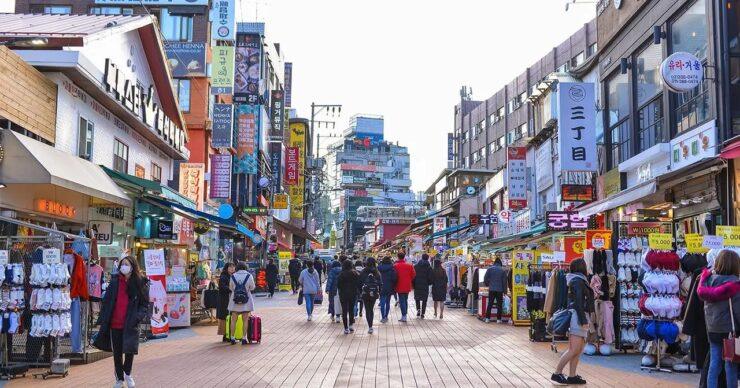
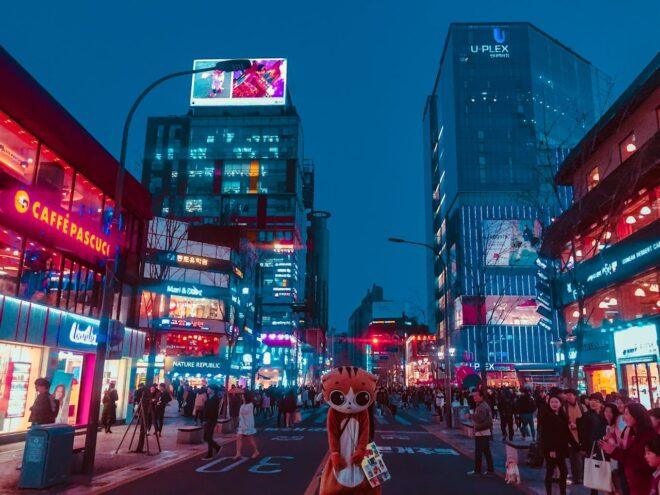
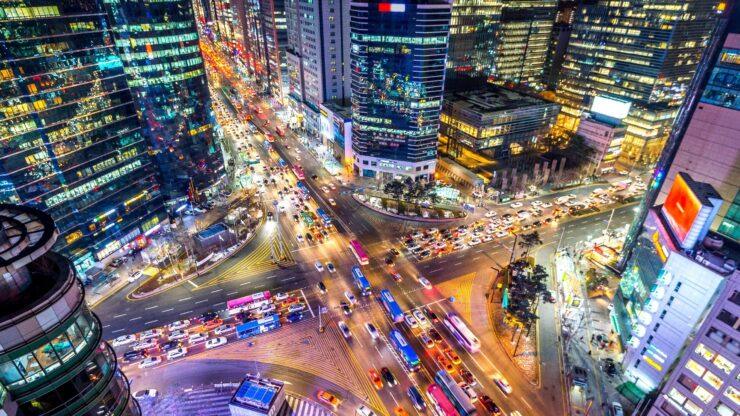
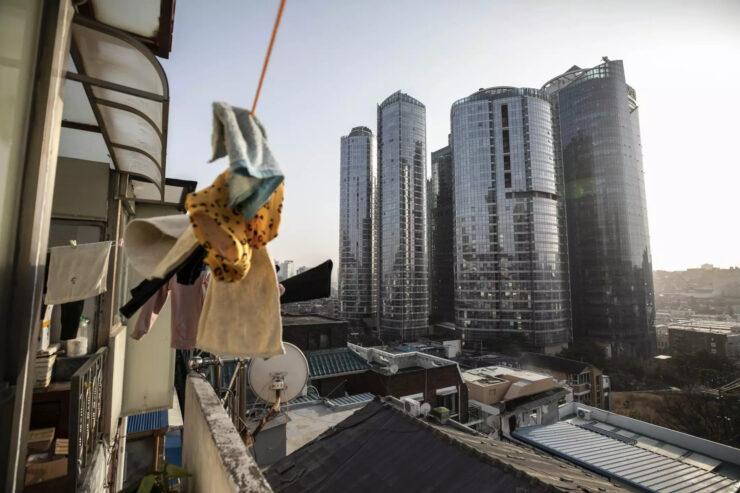
Seoul: beyond the K-Wave showcase, inside the real city

36 Min Read

The K-Wave Facade and the City’s Hidden Face


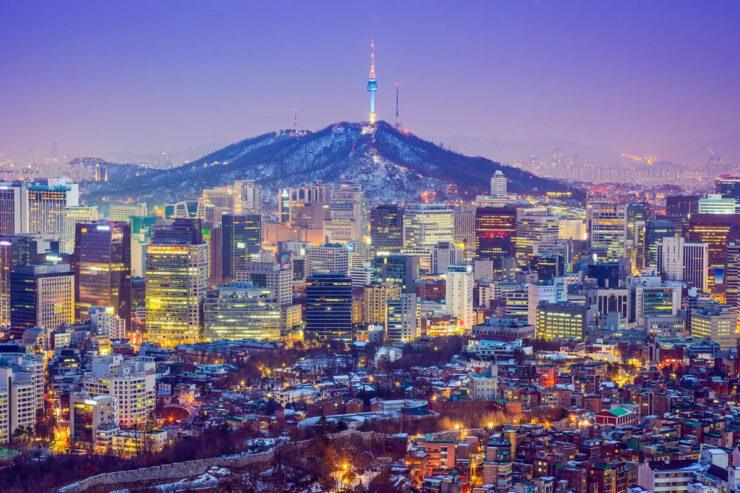
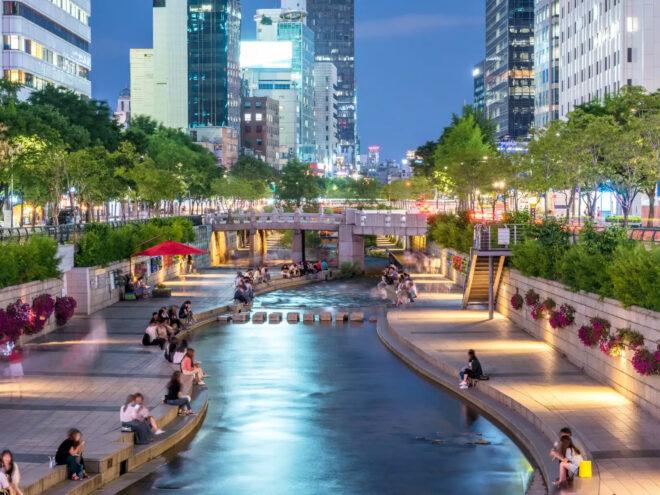
Over the past two decades, Seoul has become the globalized image of Asian modernity: glass-and-steel skylines, smart parks, driverless trains, cultural festivals, and an irresistible urban storytelling powered by the Korean Wave. TV dramas, K-pop music videos, and digital content build a powerful, aspirational narrative: Seoul as the city of the future, where tradition and innovation coexist in harmony.

Yet behind the polished surface of this international success, what realities truly inhabit its neighborhoods? Who can afford to live—and remain—in South Korea’s capital? And what remains invisible in the aesthetic representation of a metropolis that sells itself to the world as a model?

This article is an attempt to look beyond the showcase, questioning the contradictions between visibility and vulnerability. For if it is true that Seoul is one of the most dynamic cities of the 21st century, it is equally true that its transformations leave open profound questions about housing justice, social relations, urban ecology, and the rights of citizenship.

To broaden the view beyond data and urban policies, this piece also draws on the perspective of Lee ChangYong, a real estate analyst working in Seoul’s financial sector and author of the Instagram profile Seoul Stride. Through his images and reflections, Seoul Stride/Lee ChangYong captures the city in its everyday details: backstreets, architectural fragments, urban transformations observed from the ground up. A gaze that weaves together analysis and lived experience, capable of revealing both the lights and the shadows of South Korea’s capital.

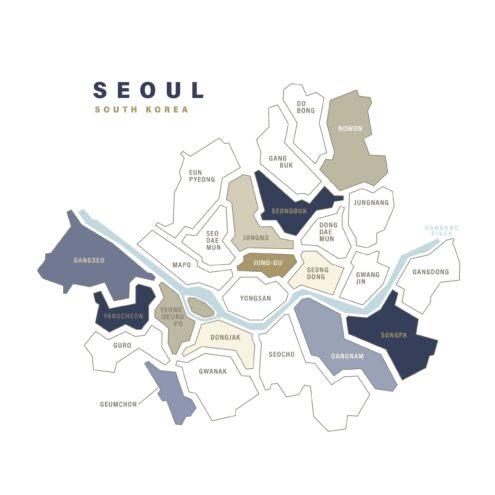
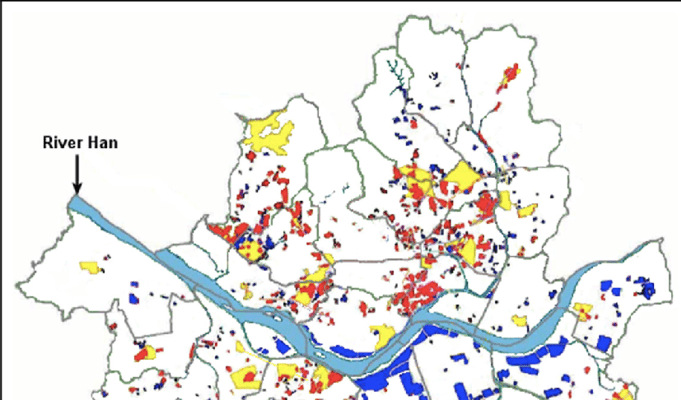
Subdivision of Seoul’s districts. Source: Etsy

When the City Heals (or Isolates): Urban Loneliness and New Forms of Social Care


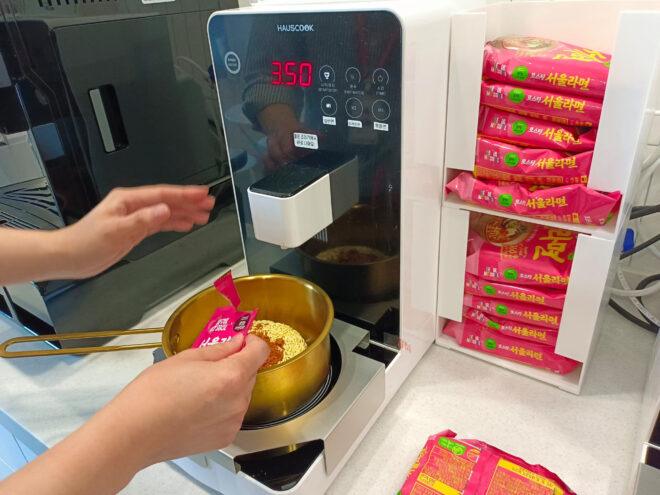
In a convenience store in the Dongdaemun district, a woman in her sixties sits in front of a steaming bowl of ramen. Across from her, a young counselor offers her a warm towel for her feet. Nearby, a young office worker listens quietly as a volunteer asks him: “How was your day?”.
We are not in a clinic, nor in a social center. This is one of Seoul’s first mind convenience stores—corner shops transformed into relational shelters, designed to tackle the growing epidemic of urban loneliness affecting the South Korean capital.

Launched in 2025 as part of the five-year plan Seoul without loneliness, these hybrid spaces—half eatery, half social counseling hub—are part of a 451 billion won investment aimed at countering a phenomenon that, according to data from the Metropolitan Government, now affects more than one in three residents.

According to a 2025 report in The Guardian, in just the first month of the program the dedicated hotline registered over 3,000 calls for help, many coming from young professionals and elderly citizens living alone. Yet this initiative, however marginal it may seem, speaks volumes about how Seoul is changing: beneath the image of a hyper-connected, ultra-modern city, deep cracks are emerging in its social, housing, and ecological fabric. Urban loneliness, housing exclusion, vertical urbanization, green gentrification, and new climate inequalities are reshaping the human landscape of the capital. And while some neighborhoods are being transformed into models of resilience, others are sinking into marginality.


The Questions Seoul Can No Longer Avoid

What does it mean, today, to build a city that is both just and ecological? What are the social costs of urban innovation? And what will become—whether for better or for worse—the new urban attractors of the next decade?

Through a journey across pilot projects of climate adaptation, neighborhoods under regeneration, slums facing demolition, and new cultural hubs, we seek to answer a fundamental question: who will have the right to remain in the Seoul of the future?

Promotional poster for the “Goodbye Loneliness 120” program

The Geographies of Emptiness: How Seoul Confronts Housing Loneliness


The initiative of the “mind convenience stores”, despite its apparent simplicity, has raised a question that has long lingered in South Korea—and especially in Seoul—without a clear answer: can a city take care of those who feel alone? And above all: which urban spaces are generating this loneliness?

Photograph: Raphael Rashid. Source: The Guardian

The Numbers of Isolation

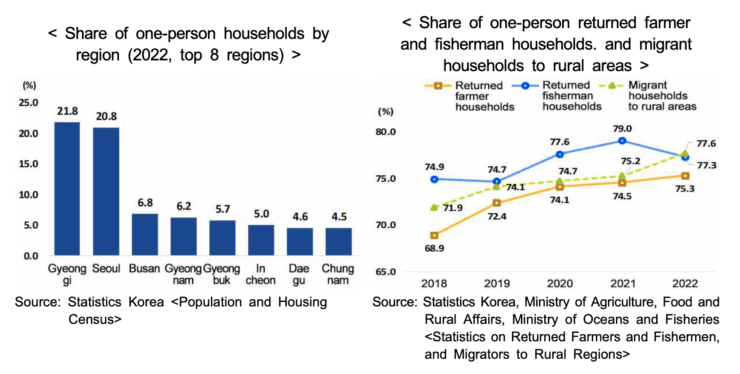
Data from Statistics Korea show that in Seoul, more than one-third of households consist of a single person, and in some districts the figure reaches 40%. This points to a profound transformation in the social fabric of the capital.

A recent study by the Seoul Institute reveals that 62% of one-person households report frequently experiencing feelings of loneliness, while more than 13% live in conditions of severe isolation. These numbers do not merely describe a relational crisis; they outline an actual urban geography of emptiness.

Distribution of single-person households in South Korea (left) and growth of single-person households among farmers, fishermen, and rural migrants (right), highlighting the rise of housing loneliness even in rural areas. Source: Statistics Korea

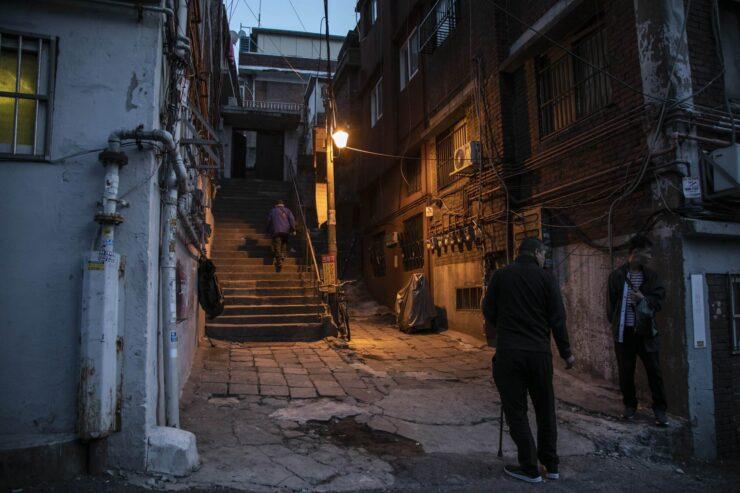
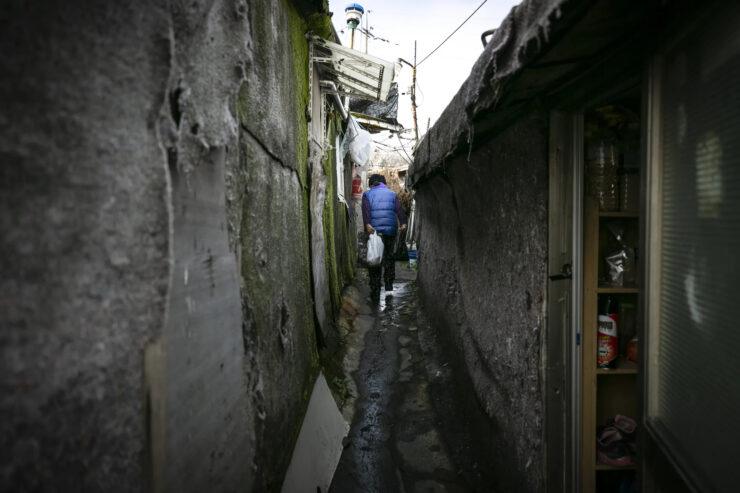
The central areas of the city, such as the districts of Jongno and Jung, are becoming emblematic sites of this phenomenon. Here, amid low, aging buildings inhabited by elderly people living alone and precarious workers, the absence of adequate collective spaces amplifies the distance between individuals. Many reside in the so-called jjokbang-chon: micro-units of less than ten square meters, often without windows or shared facilities, where every activity—eating, sleeping, washing—takes place within the same room. In these environments, originally conceived as emergency solutions, the boundary between loneliness and deprivation is virtually nonexistent.

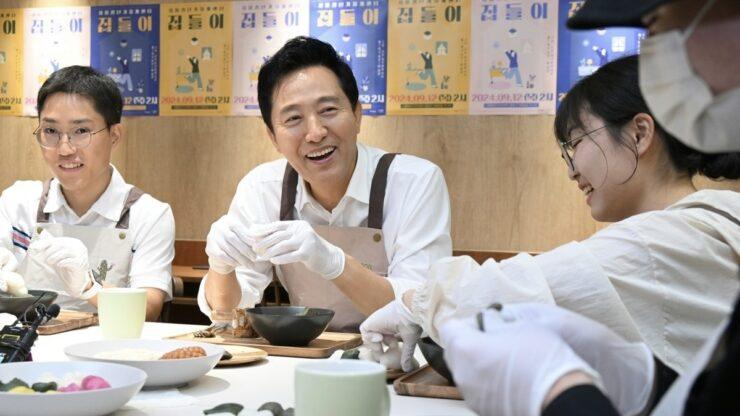
Seoul Mayor Oh Se-hoon prepares traditional sweets with young people who have experienced isolation, during the opening of the new space at the Seoul Youth Restart Center (September 12, 2024). Source: The Korean Herald
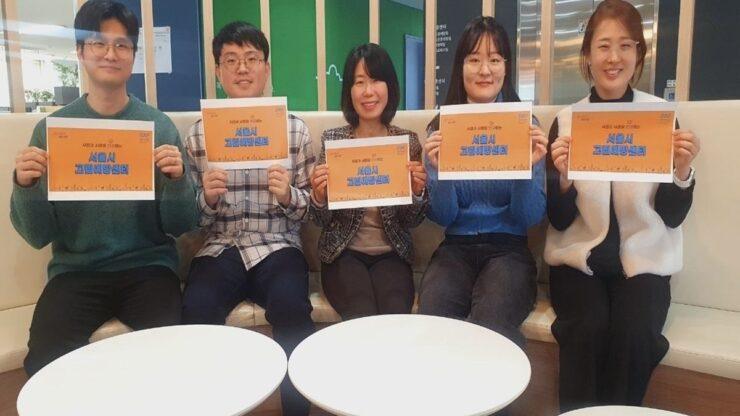
The team of the Seoul Isolation Prevention Center—the first national center dedicated to preventing social isolation and “lonely deaths”—strengthens its commitment to providing emotional support and proximity services on an urban scale. (Source: The Korean Herald)

The Paradox of Regenerated Neighborhoods

Some urban regeneration projects have, paradoxically, contributed to fostering new forms of isolation. The case of Ihwa-dong and its Mural Village is emblematic: conceived as a public art intervention to revitalize the neighborhood and attract tourism, it ultimately excluded many of the original residents—largely elderly and low-income—overwhelmed by noise, photography, and invisibility. Here, urban planning spoke more to visitors than to residents, leaving loneliness intact behind closed doors.

The Seoul without loneliness plan, announced in 2024, was designed precisely to counter this drift. It includes services such as neighborhood listening desks, community cafés, small public spaces for rest and encounter, as well as a 24-hour hotline that, in its first months, according to The Chosun Daily, received more than 3,000 calls for help. Yet criticism abounds. Many experts describe these as “social patches,” stopgap measures that fail to address the deeper causes: a fragmented housing culture, an urbanism still oriented toward performance rather than proximity, and a built environment that discourages human connection.

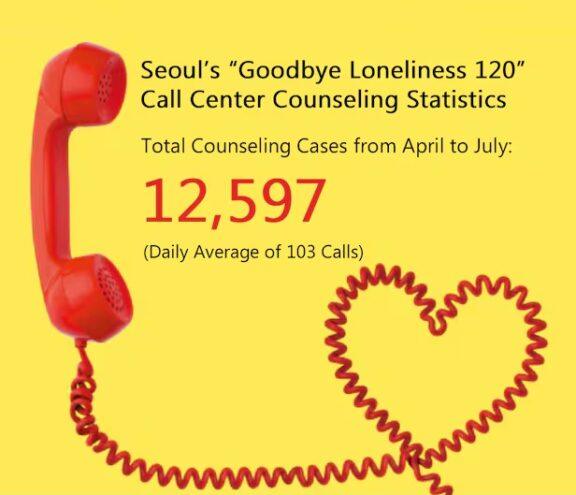
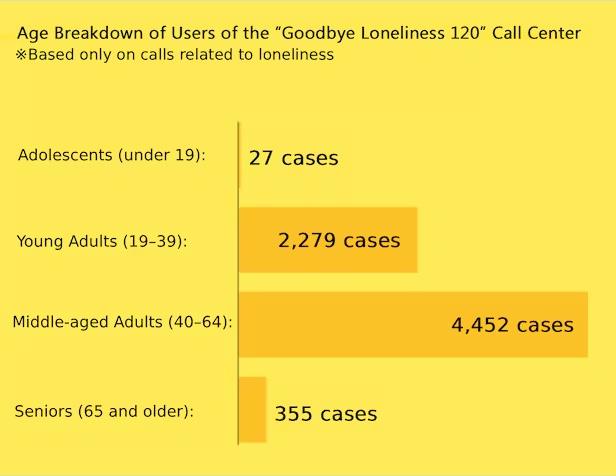
The “Goodbye Loneliness 120” hotline, launched in 2024, received over 12,500 calls in just a few months, mainly from adults aged 40 to 64. A warning sign of the growing extent of urban loneliness in Seoul. (Source: Seoul Metropolitan Government). Graphic by Kim Sung-kyu

The Map of Urban Isolation

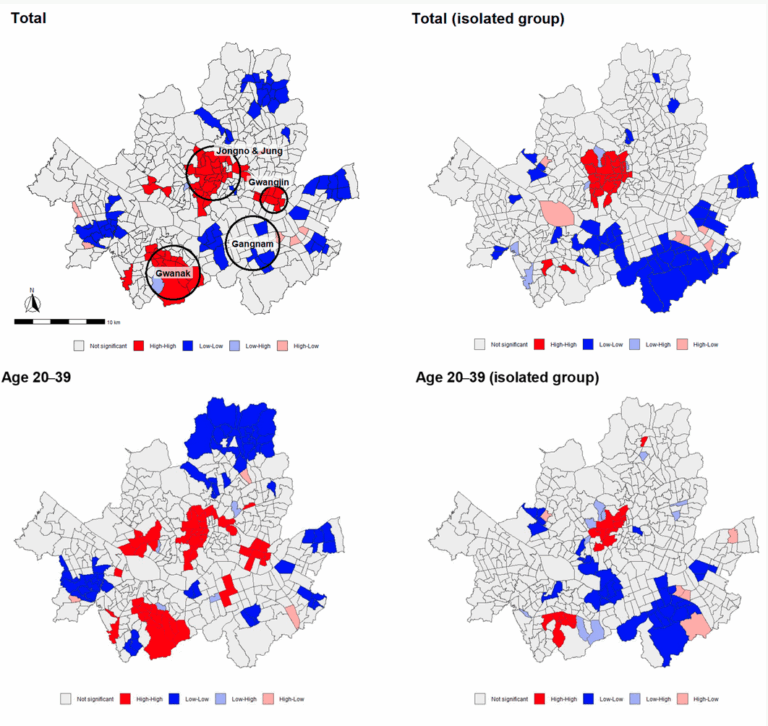
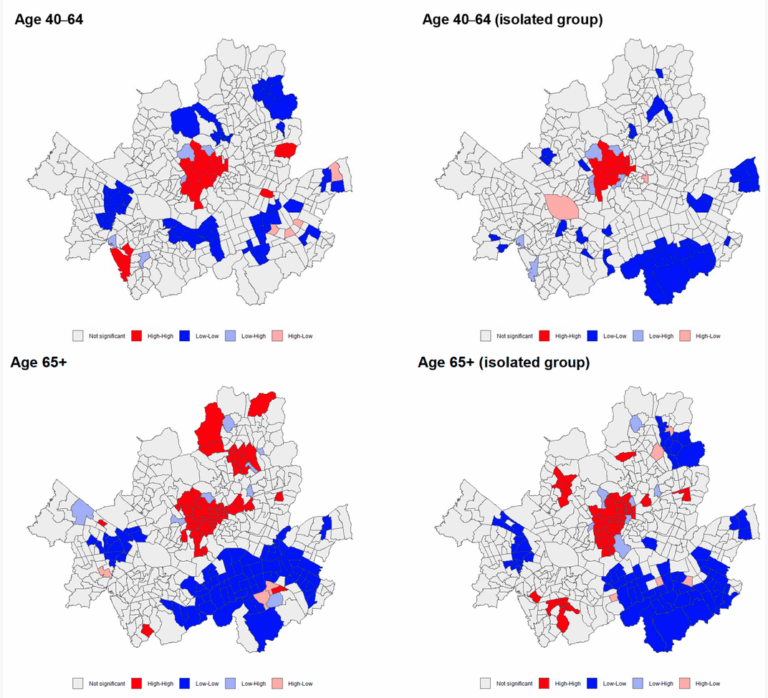
This interpretation is confirmed by a study published in Sustainability, which cross-referenced demographic data with mobility behaviors tracked through mobile signals. The result is a disturbing map: the loneliest people move less, inhabit the same marginal areas, and have very limited access to quality public spaces. Loneliness, therefore, clusters in the least porous places—where there is no chance to meet by accident, to sit, linger, or talk. It is not an emotion randomly distributed, but a spatial effect.

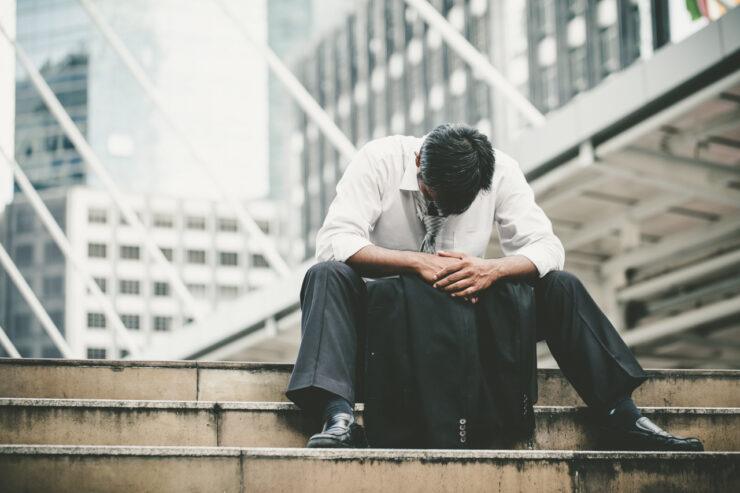
Man sitting alone on a staircase. Source: The Korean Herald

Adding to this fragile scenario is the weight of economic dynamics. As noted by Lee ChangYong, a real estate analyst based in Seoul:

“In Korea, it is possible to finance up to 80% of a home’s value. With interest rates this sensitive, a 1% increase equals an extra month’s salary for the average resident. That burden inevitably falls on tenants, who are left with the choice of either enduring it or moving elsewhere.”Lee ChangYong


Urban loneliness, then, does not stem only from inhospitable spaces or weakened social networks, but also from financial mechanisms that accelerate housing precarity and reduce the chances of remaining in central areas.


Toward Relational Planning

In this context, the task of urban planning cannot be limited to designing physical infrastructures. What is needed are policies capable of fostering trust, of restoring meaning to shared living, of filling the relational voids that have opened up in the folds of the contemporary city. Seoul, with its contradictions and experiments, shows how urgent it is to envision a form of relational planning—where encounters are not a side effect, but a designed right. Only then can a city truly be considered inclusive—not when it is faster, taller, or more efficient, but when it is less alone.

LISA maps of social isolation clusters in Seoul by age group (20–39, 40–64, 65+) and isolated groups: red areas highlight a significant concentration of lonely individuals, while blue areas indicate low incidence. The phenomenon is unevenly distributed, with particular intensity in central and southeastern districts. (Source: MDPI)

The Iconic Neighborhoods Under the Lens: What Does It Mean to Live in Hongdae, Itaewon, and Gangnam?


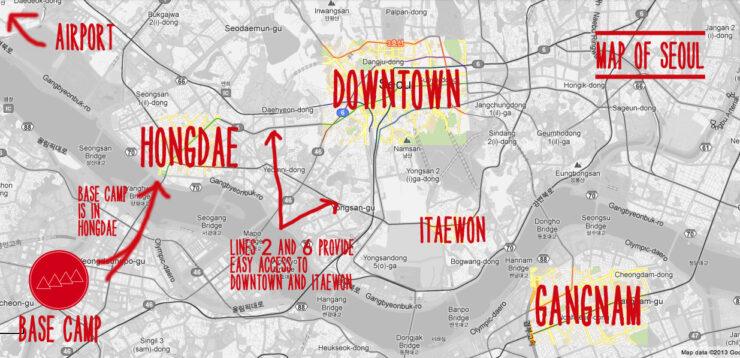
In the very spaces that fill travel guides and lifestyle apps—Hongdae, Itaewon, Gangnam—the processes of globalized visibility intertwine with those of urban isolation. But what does it actually mean to inhabit, to live, or even to work in these transforming areas?

LEGGI ANCHE  Storytelling Architecture: Hoehyeon Demonstration Apartments.
Source: Seoul Base Camp

Hongdae: Independent Creativity and Commercial Gentrification

Hongdae, the neighborhood that grew around Hongik University, has for decades been a cultural crossroads for young artists, indie musicians, and street performers. Its bohemian atmosphere, nurtured by deeply rooted artistic communities, turned the area into an international hub: boutique hotels, creative markets, nightlife, and global tourism have all contributed to its image as a “cool,” alternative district.

Yet behind this lively facade lies a more controversial dynamic. Academic studies, available through MDPI, show how the very cultural appeal that made Hongdae a global icon has also accelerated processes of commercial gentrification: the proliferation of trendy businesses and rising property values have reduced space for long-term residents and marginalized many of the very artists who once made the neighborhood authentic and innovative.

In Hongdae, cultural vitality has gone hand in hand with commercial gentrification, putting at risk the very communities that created it.

Shopping streets in Hongdae. Source: Creatrip

Itaewon: Cosmopolitanism and Degentrification

Itaewon, famous for its cosmopolitan character and the LGBTQ+ community of Homo Hill, offers a different example of an iconic neighborhood. Born as a historic enclave near the U.S. military base and as a multicultural meeting point, today it is also the stage for more recent gentrification: venues turned into luxury lounges, skyrocketing rents, and tensions between international residency and community identity.

A semantic analysis published in MDPI highlights a unique paradox: Itaewon now displays a coexistence of cosmopolitan vibrancy with growing degentrification, where exclusivity in some areas contrasts with the loss of vitality in others.

A glimpse of Itaewon and its nightlife. Source: Voyeglobal

Gangnam: Economic Success and Performative Isolation

Gangnam, a global symbol of economic success and urban elite—immortalized in the famous Gangnam Style—is a layered urban landscape of mega shopping malls, luxury residences, prestigious schools, and cosmetic clinics. Here, housing pressure is so intense that simply living in the area is considered a marker of success.

But who actually lives here? Single-person households, often young professionals, represent a growing share of the urban population, but within contexts where social interaction is already mediated and performative.
Gangnam’s economic success hides a form of performative loneliness, where public life is dominated by consumption rather than connection.

The Gangnam district. Source: Agoda

The Paradox of Neighborhoods “Always Crowded Yet Lonely”

In all three cases, a paradox emerges: symbolic districts buzzing with tourism and culture, yet often lacking urban spaces that foster spontaneous, close-knit relationships. Many residents describe them as neighborhoods “always crowded yet lonely,” where tourism and commerce diminish the chances for genuine encounters. In Hongdae and Itaewon in particular, the popular urbanism of the 1990s has given way to real estate investments favoring short-term rentals and services for creatives, rather than co-housing or spaces for everyday social life.

A recent study on Seoul shows that high-intensity tourist areas display high mobility indicators but very limited resident interaction: the result is a mix of commercial vibrancy and human isolation. The neighborhood is crowded during the day and empty in its homes at night. In the urban topography of tourism, even social life becomes consumable.


Global Culture, Invisible Margins

In short: culture, urban marketing, and global visibility have created symbolic centralities for Hongdae, Itaewon, and Gangnam. But behind these centralities lie invisible margins—relational voids where the city no longer communicates. Tourists see lights, music, events; residents often see walls, gates, and elevators. It is an urban landscape of contradictions, where expansion and solitude coexist in surprising ways.


New Urban Polarities: Between Creative Storefronts and Invisible Gentrification


If loneliness and consumer tourism turn iconic neighborhoods into crowded yet empty stages, the housing crisis and urban regeneration strategies reveal another deep fracture: the divide between those who have the right to stay and those who are systematically pushed to the margins. In a city that grows through attraction rather than inclusion, the residential landscape becomes a mirror of inequality.


Housing Survival in Micro-Spaces

In the heart of the capital, districts like Jongno and Jung host a significant share of the most vulnerable population, forced to live in the so-called jjokbang-chon: micro-studios of less than ten square meters, often without windows or shared facilities, where every domestic function—sleeping, eating, washing—takes place within the same cramped room. In a study published by Elsevier in 2024, these forms of compressed housing are described as conditions on the edge of urban survival, disproportionately affecting single men, the elderly, and migrant workers.

The contrast between the so-called jjokbang-chon and luxury residential skyscrapers in the heart of Seoul. Source: Los Angeles Times
In the jjokbang-chon, urban marginality intertwines with housing decay and social loneliness. Among peeling walls and precarious facilities, the residents are often elderly people living alone, precarious workers, and those excluded from ordinary housing circuits. Source: Los Angeles Times

But transformations do not depend solely on urban strategies: financial leverage plays an equally decisive role.

“With the drop in home sales, monthly rentals are now at an all-time high,” observes Lee ChangYong. “The average rent in Seoul is approaching 1.5 million won, and especially in central areas, the most sought-after apartments are increasingly small, occupied by smaller households and high-income residents.”


Guryong Village: The Last Slum in the City of the Future

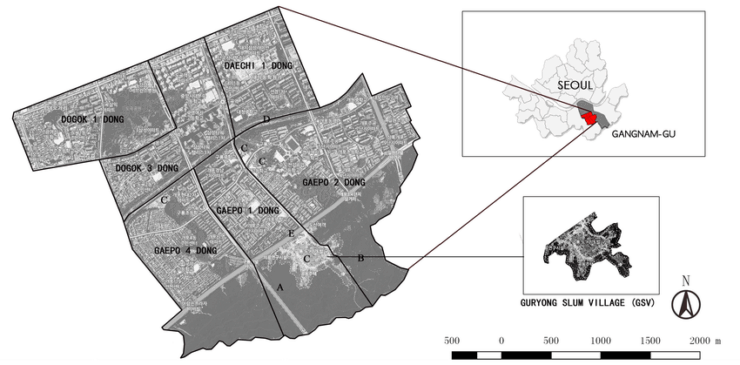
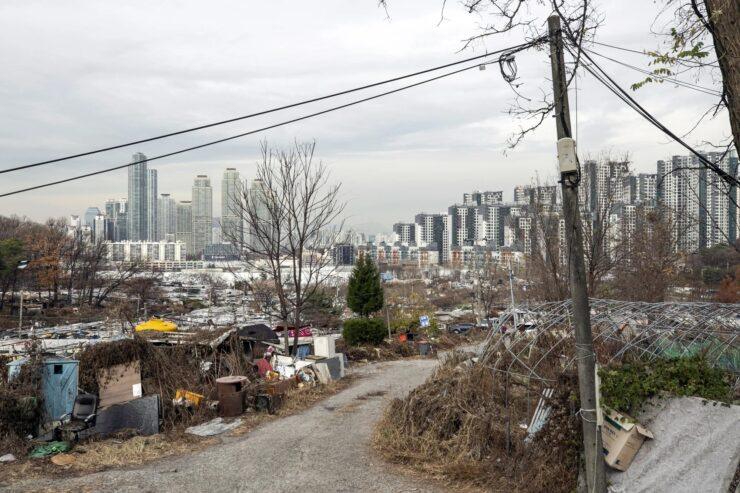
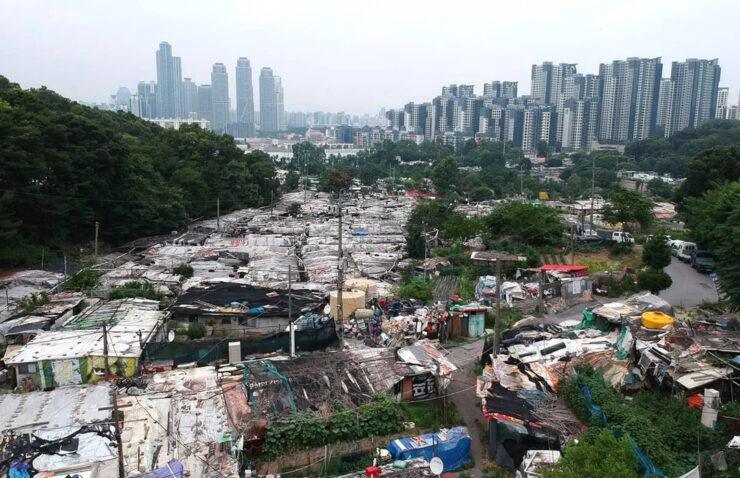
In Gangnam, at the starkest contrast, Guryong Village still endures—the city’s last official slum: an irregular sprawl of shacks standing in the shadow of luxury skyscrapers. Authorities have promised its complete demolition by 2025, yet delays in relocation plans and protests from residents, who denounce the lack of dignified alternatives, continue to obstruct the process.
It stands as the symbol of a city that expels poverty rather than confronting it.

Location of the Guryong Village area in the Gangnam district. Source: ResearchGate

Virtuous Models: Integrated and Inclusive Regeneration

In response to these critical issues, Seoul has over time developed very different strategies of urban transformation. In the neighborhoods of Jangwi-dong and Sangdo 4-dong, starting in 2014, integrated regeneration projects were launched that combined climate resilience with social inclusion. Urban gardens, green roofs, rainwater harvesting systems, and improved sewage networks were implemented thanks to active collaboration between resident communities and institutions. Today, these two districts are considered virtuous models of proximity-scale urban planning, also cited among international best practices by Buildings & Cities [2022].


The Moa Housing Model: Soft Densification

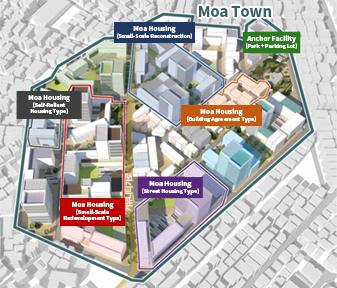
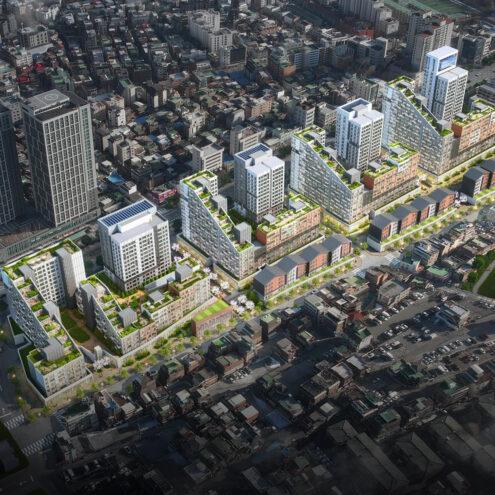
Alongside these examples stands the Moa Housing model, introduced in 2022 as an incremental response to the housing crisis in obsolete urban fabrics. Unlike large-scale demolitions, Moa allows small, low-density plots to be aggregated in order to build more functional residential complexes, equipped with green areas, underground parking, and essential infrastructure. With timelines cut in half compared to conventional interventions—about five years instead of ten—the plan foresees the creation of 30,000 new housing units by 2040. The project is supported by the Seoul Metropolitan Government, which describes it as a “soft” strategy capable of preserving existing social networks while valuing human density as an urban resource.

The “Moa Town” project in Seoul aims to redevelop low-density areas through diverse integrated housing models, addressing chronic issues and expanding the supply of quality housing. Source: Seoul Policy Archive

Yongsan Dreamhub: The Showcase City That Never Was

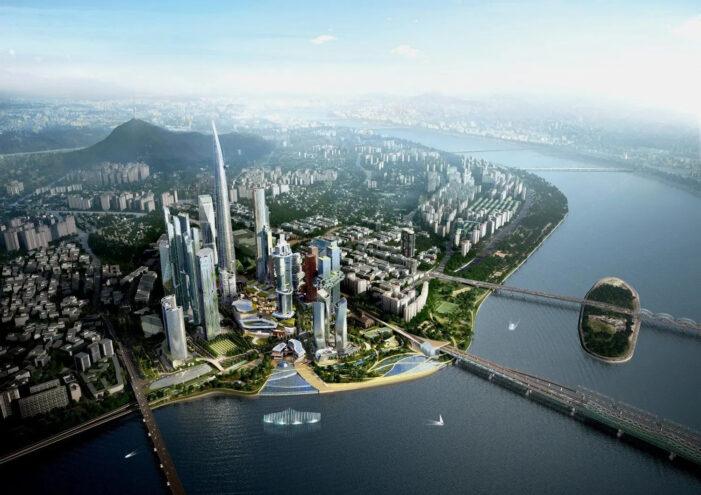
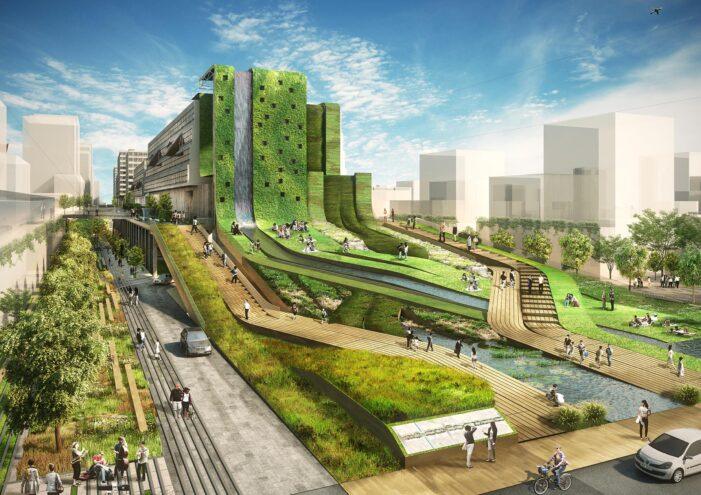
At the opposite end of the spectrum lies the Yongsan Dreamhub project, conceived in the 2000s as a vertical mixed-use district, designed to host residential towers up to 300 meters high, connected by a suspended panoramic platform. Cancelled in 2013 due to financial difficulties, the project remains an archetype of the Seoul imagined to attract international capital rather than respond to local needs. A vision of a showcase city, where density is not about relationships but about spectacle.

Scenario proposed by MSP for the redevelopment of the Yongsan district within the Dreamhub Project. Source: MSP

Three Visions of Urban Future

These three trajectories—ecological regeneration with inclusion, incremental shared transformation, and symbolic vertical development—tell opposing stories of urban futures. On one side, communities reconfiguring their habitats with light, rooted tools; on the other, mega-projects multiplying real estate value without reducing marginality. In between lies the crucial question: who is actually heard in processes of urban transformation?

To believe that regeneration is always synonymous with equity means assuming that decisions are designed with, and not only for, those who inhabit. In a Seoul where the distance between center and margin is not only geographic but also social and symbolic, the only sustainable urbanism will be the one that recognizes the right to remain as its founding principle. Because a roof is not enough: what is needed is a space that enables living—not merely surviving.


Behind the Polished Facades: Gentrification and Exclusion in the “New Seoul”


In a Seoul increasingly eager for global recognition, urban regeneration projects are creating new image-neighborhoods that embody the aspiration to modernity, design, and innovation. Yet behind these facades emerge deep contradictions affecting those who live, those who work, and those who are excluded from the urban spectacle.


The Mechanisms of Urban Gentrification

Numerous studies document how urban regeneration processes in Seoul, if not accompanied by adequate social safeguards, can become catalysts of gentrification. In many cases, rising property values and the attractiveness of new interventions end up marginalizing the most vulnerable segments of the resident population. The Seoul Solution Archive itself acknowledges these risks and stresses the need for participatory strategies capable of preventing depopulation, the erosion of community networks, and the transformation of neighborhoods into spaces reserved exclusively for more privileged residential targets.

LEGGI ANCHE  SBAU - The Seoul Biennale of Architecture and Urbanism: A Laboratory for the Future of Cities


The Cheonggyecheon Case: Green Gentrification

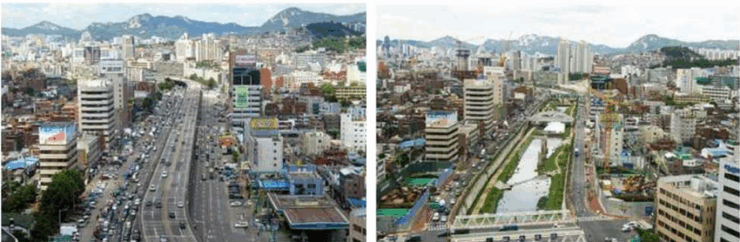
An emblematic example of controversial urban regeneration is the restoration of the Cheonggyecheon, the waterway running through downtown Seoul which, after the demolition of the overpass above it, was uncovered and transformed into a 5.8 km urban ecological corridor. Inaugurated in 2005 as part of an ambitious renaturalization project, it improved environmental quality in the area, enhanced local biodiversity, and increased the city’s tourist appeal.

However, this restoration also produced significant side effects. As highlighted in the study by Heeji Lim et al., the project triggered a rapid process of green gentrification: property prices in the surrounding area rose sharply, driving up land values and favoring the settlement of high-end businesses at the expense of local shops and lower-income residents. In this sense, the Cheonggyecheon stands as a powerful symbol of how ecological improvements can become a vehicle of socio-economic exclusion when not accompanied by adequate housing protection policies.

The Cheonggyecheon stream, before and after the 2005 ecological restoration project. Source: ResearchGate
The Cheonggyecheon stream, at its terminal section near Seoul City Hall. Source: Dynasty Korea

Seongsu-dong, the “Brooklyn of Seoul,” and Euljiro, the Fight to Preserve Historic Craftsmanship

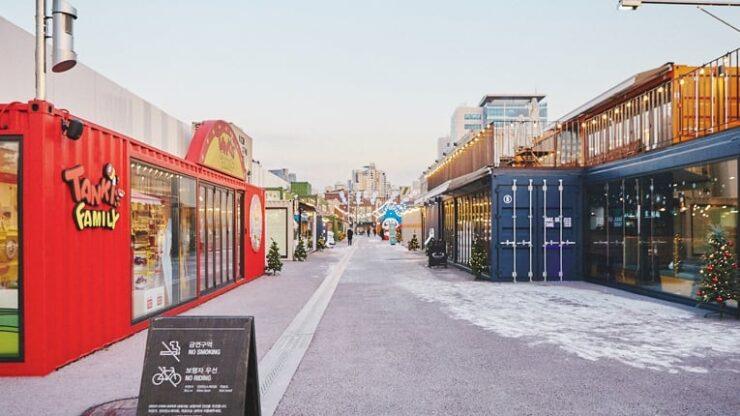
New image-districts often emerge on industrial archeologies: an emblematic case of aesthetic regeneration is Seongsu-dong, once an industrial hub known for its shoemaking industry. Today it is celebrated as the “Brooklyn of Seoul” for its creative atmosphere, with former factories converted into design cafés, artist studios, concept stores, and visually striking showrooms. The urban narrative surrounding it highlights the reuse of post-industrial spaces as engines of cultural innovation and tourist appeal Asiance.

Yet this metamorphosis comes with a social cost that is often overlooked: many members of the original artisan communities, unable to cope with rising rents and space conversions, have been gradually excluded. The Seongsu model, seemingly virtuous, therefore raises crucial questions: what is the price of urban beauty? And who is left out when the city renews itself to be photographed rather than lived in?

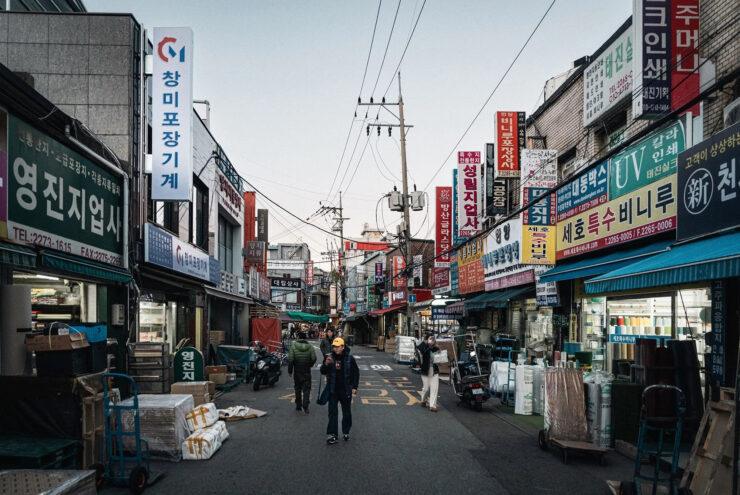
Similarly, in Euljiro—an historic neighborhood of craftsmen, blacksmiths, and print shops—“bottom-up” regeneration has clashed with mounting real estate pressures favoring galleries, start-ups, and trendy venues, often disregarding the long-standing community. Activists, artists, and artisans have mobilized to reclaim their right to the city, opposing the erosion of the neighborhood’s original productive and social fabric.

In Seongsu-dong, once an industrial district of Seoul, shipping containers are transformed into boutiques and cafés: productive archaeology becomes a creative and commercial hub. Source: Yun Journal
The Euljiro area—between industrial workshops, traditional markets, and street food—preserves an authentic, lively soul in the heart of Seoul. Source: Barrettish

The Invisible Population of Urban Transformations

The question then becomes: what happens to the population already living in these neighborhoods before transformation takes place? The answer is often forced relocation elsewhere—to peripheral areas or low-quality housing—while new residents enjoy economic and cultural centrality. The phenomenon is not new: Shin Ho-Baek (2015) and colleagues described gentrification as a process embedded within a “developmental urban state,” where alliances between government, major real estate firms, and speculative development produce a radical socio-spatial restructuring, displacing long-standing residents.


Image-Neighborhoods and Social Exclusion

The result is problematic both urbanistically and ethically: new image-neighborhoods emerge, built on green branding, mass culture, and consumer lifestyles. Yet in none of these contexts is access to housing guaranteed for those without social or economic capital. Seoul becomes visible—but for whom? And what happens to the displaced residents? The evident risk is that urban projects become more performative than habitable, more aesthetic than solidaristic.

The observation of Lee ChangYong adds a crucial layer:

“In the end, ordinary people will be pushed out to the outskirts. Whether intentional or not, the transport network connecting the center to outer areas is already ready to sustain this shift.” — Lee ChangYong

Identification of redevelopment areas as of 2008 in the Seoul metropolitan area. Source: ResearchGate

Seoul, Between Global Aspirations and Everyday Realities


Seoul is a city that looks to the future: it builds linear parks along rediscovered rivers, renews industrial neighborhoods into creative districts, and transforms local markets into showrooms for the world. Yet between the polished renderings and everyday lives, cracks appear that are hard to ignore: housing loneliness, urban inequalities, and social displacement disguised as regeneration.


The Contradictions of Urban Progress

The new centralities tell the story of an ambitious metropolis, but not always an accessible one. Projects intended to restore livability and beauty to forgotten spaces often end up benefiting only those who already have access to resources. Public green comes hand in hand with rising rents; density does not generate community but isolation; urban innovation does not automatically translate into social justice.

Who will truly benefit from the new parks, housing policies, and climate infrastructures? Who will be able to afford to live in regenerated neighborhoods, beside the new green stations, breathing the clean air of urban marketing? And who, instead, will be left behind—displaced, excluded, silenced—within the invisible margins of the metropolis?

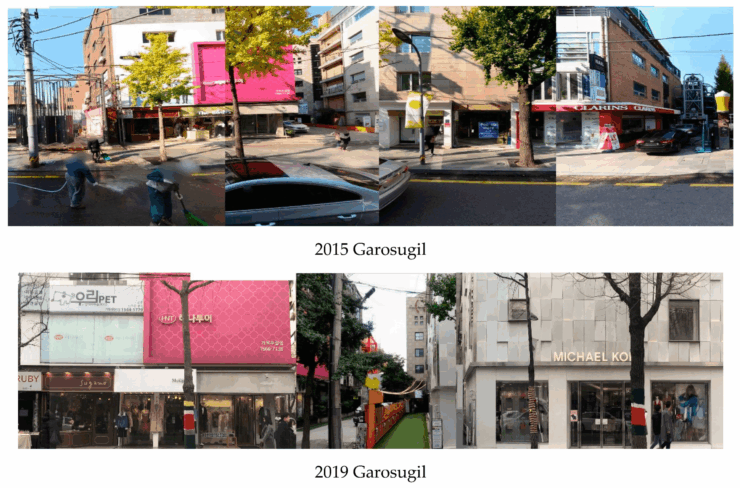
Garosugil before and after gentrification: between local shops and global brands, the face of the neighborhood changes in just a few years. Source: MDPI

Rethinking the Model of Development

It is not a matter of abandoning the urban dream, but of transforming it. Of shifting the idea of progress: from vertical growth to horizontal equity; from the aesthetics of place to the care of relationships. A just city is not the one that shows itself best, but the one that welcomes the most. A resilient city is not only technological, but also human. A livable city is not only dense, but permeable to differences and vulnerabilities.


Toward a Livable Seoul

Seoul presents itself to the world as a laboratory of the future, but the challenge will be to make that future livable also for those who today remain at the margins. To do so, it will need to unlearn part of its triumphant narrative and accept that true innovation is not measured in skyscrapers but in proximity.
If it truly wishes to be less lonely rather than merely greater, Seoul will have to stop designing itself to be admired and begin reimagining itself as a city to be lived in, not just looked at.

From utopian renderings to invisible slums: Seoul oscillates between futuristic visions and marginalized realities that rarely enter the public discourse on urban regeneration. Source: Reddit and AoArchitect

A Conversation with Lee ChangYong (Seoul Stride)
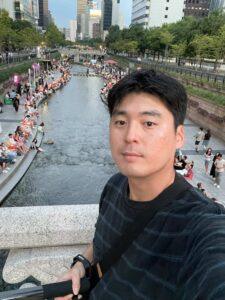


The quotations cited throughout this article have shown how financial mechanisms directly shape Seoul’s urban landscape, complementing the social and spatial reading with a more structural dimension. To go beyond data and statistics, we asked a few questions to Lee ChangYong, a real estate analyst working in Seoul’s financial sector. The result is a dialogue that captures, in simple yet direct words, how interest rates, market dynamics, and policy choices are reshaping the city—accelerating processes of gentrification and exclusion.

Q: From your professional perspective, how do you see the relationship today between financial policies (interest rates, lending conditions) and housing market dynamics in Seoul?
A: Interest rates are the key factor. According to data from the Bank of Korea, the variable rate has entered the 3% range for the first time in three years, currently at 3.99%. If it goes down, housing prices are likely to rise. Of course, we can’t be certain it will continue to fall, but the correlation is direct.

Q: How does the rise in borrowing costs affect tenants and fuel gentrification?
A: In Korea, you can borrow up to 80% of a property’s value. For the average Seoul resident, a 1% increase in interest rates means sacrificing the equivalent of a full month’s salary just to pay the bank. That burden inevitably falls on tenants, who are then forced either to accept tougher conditions or to move elsewhere. It’s an accelerator of gentrification.

Q: What does the rise of monthly rentals mean for different household types in Seoul?
A: In Korea—especially in Seoul—housing contracts usually fall into three categories: sale, jeonse, and monthly rent. Jeonse allows a tenant to deposit about 70% of the property’s value and live rent-free for two years, with the option to renew. But this system is losing popularity among landlords: not only because it doesn’t generate monthly income, but also because by law tenants can request an additional two-year extension, which owners can refuse only if they intend to move in themselves. On top of that, any increase in the deposit upon renewal is legally capped at 5%, making it unprofitable. As a result, many landlords now prefer monthly rent, which in Seoul today averages close to 1.5 million won. This shift favors smaller units and smaller households with medium to high incomes, particularly in central areas.

Q: Looking ahead, do you expect Seoul to follow Tokyo’s trajectory, with the city center increasingly dominated by major investors?
A: Yes, it’s already happening. More and more central properties are being acquired by REITs or large-scale owners, while ordinary citizens are being pushed out to the outskirts. Seoul’s transport network connecting the center to outer areas is excellent and, whether we like it or not, it’s sustaining this transition. I’m not sure whether to laugh or cry about it, but the process is already underway.

If you’d like to see Seoul through his eyes, you can follow Lee ChangYong on Instagram at Seoul Stride.

Share This Article
Follow:
I am a landscape architect and a Ph.D. candidate in Urban Planning, observing South Korea through the intersections of design, urban space, social change, and architectural tradition. As a devoted fan of K-pop and K-dramas since 2018—and an ARMY and ATINY at heart—my research is deeply connected with my exploration of contemporary cultural dynamics.