

In today’s world of accelerated urbanization and increasing climate threats, cities are being called upon to reinvent themselves to ensure sustainability, resilience, and quality of life. Within this global landscape, South Korea stands out for its innovative approach to architecture and urban planning, with Seoul emerging as a living laboratory for cutting-edge urban solutions. The Seoul Biennale of Architecture and Urbanism (SBAU) serves as the international showcase of this creative momentum—an event that merges vision, technology, and tradition to imagine the cities of the future.
Bridging Tradition and Innovation
Globally recognized for the “four Ks”—K-pop, K-drama, K-beauty, and K-food—Seoul is also a hub of excellence in architecture and urbanism. The South Korean capital is a living laboratory where tradition and modernity converge, giving rise to innovative solutions that respond to contemporary urban challenges. In this context, the Seoul Biennale of Architecture and Urbanism (SBAU) has established itself as a major international forum.
Launched in 2017, the Biennale explores today’s urban challenges with a focus on building sustainable cities for the future. More than just an exhibition of architectural projects, the event functions as a platform for dialogue and collaboration among designers, urban planners, and global communities, addressing critical issues such as climate change, urban resilience, and sustainable innovation.
Venues: Spaces for Dialogue and Creativity
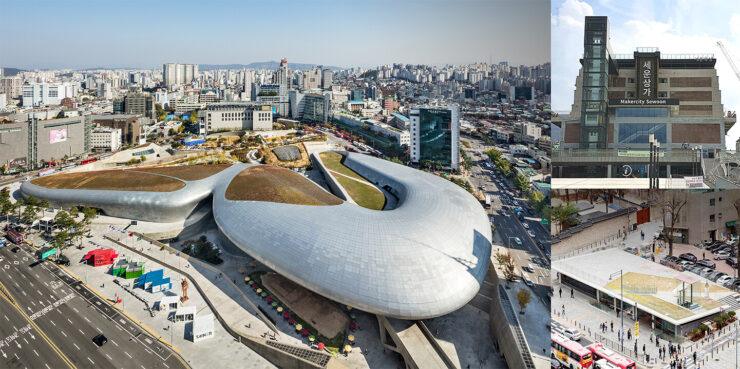
Held biennially between September and November, the Biennale unfolds across several iconic sites in the city. The Dongdaemun Design Plaza (DDP)—designed by Zaha Hadid—is one of the event’s main venues. Its futuristic form reflects Seoul’s forward-thinking ethos and hosts the most significant exhibitions, combining architecture, art, and design.
The Seoul Hall of Urbanism & Architecture is another key venue, exclusively dedicated to exploring architecture’s ties with urban life. Additional events take place at Seoul City Hall and across multiple galleries in Insadong and Gangnam, including workshops, installations, and lectures that engage the broader public and spread the event citywide.
SBAU in the Global Context
The Seoul Biennale is part of a wider ecosystem of international events that shape contemporary architectural discourse. Among the most prominent is the Venice Architecture Biennale (since 1980), followed by the Chicago Biennial, the São Paulo Biennial—notable for its focus on social and environmental issues in Latin America—the Shenzhen-Hong Kong Biennale, which explores the intersection of design, urbanism, and tech in Asia, and the Rotterdam Biennale.
What sets Seoul apart is its particular focus on the challenges of high-density urbanization, and its ability to integrate both Asian and Western perspectives in shaping future cities.
Thematic Journey: Past Editions
Each edition of the Biennale revolves around a central theme guiding exhibitions, workshops, and discussions:
2017: Imminent Commons
Curated by Alejandro Zaera-Polo and Hyungmin Pai, the inaugural edition focused on urban commons—shared resources essential to city life, such as air, water, public spaces, and digital infrastructure. Projects like The Air Commons and Digital Commons underscored the importance of sustainable approaches to shared assets.
2019: Collective City
With curators Lim Jaeyong and Jeffrey Johnson, this edition explored the collective dimension of cities, emphasizing how social collaboration and co-creation can improve urban life. Projects such as The Shared City and Resilient Networks highlighted the potential of social infrastructure to foster solidarity and civic engagement.
2021: Crossroads: Building the Resilient City
Directed by Dominique Perrault, this edition centered on urban resilience, examining how cities can adapt to global crises like climate change and pandemics. Innovative proposals like Flood-Resilient Architecture and Adaptive Urban Landscapes offered sustainable solutions to urgent environmental challenges.
2023: 100-Year Masterplan for Seoul
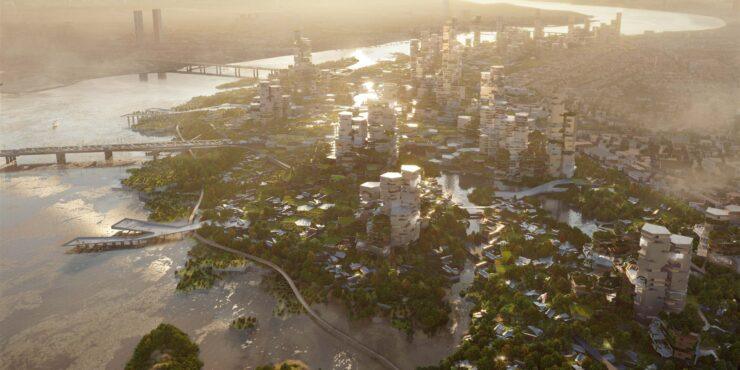
Curated by Katherine Harvey, this edition focused on long-term urban planning, with a strong emphasis on sustainability and integrating nature into the cityscape. The Hyper-Abundant City project envisioned transforming Seoul’s Apgujeong district into a resilient riverfront ecosystem with green infrastructure and open public spaces.
The 2025 Edition: New Visions for More Humane Cities
The fifth edition of the Biennale, scheduled from September 1 to October 31, 2025, will be led by Thomas Heatherwick as General Director and Curator. The British architect and designer, known for his multidisciplinary and human-centered approach, aims to make the Biennale more accessible and participatory, directly engaging Seoul’s residents in the conversation about urban design.
The core theme will be the creation of more joyful, engaging, and human-centered cities. Through a public participation program, ten multidisciplinary teams will work with local communities to explore two central questions:
“How do buildings make us feel?”
“How can they be transformed to foster deeper human connection?”
The 2025 Biennale will feature several key sections:
– Thematic Exhibition: Curated by Byoung Soo Cho and Eui Young Chun, focusing on Land Architecture and Land Urbanism, examining how built environments can harmonize with nature.
– 100-Year Masterplan for Seoul: Curated by Byoung Soo Cho, presenting a long-term vision for Seoul’s urban development.
– Guest Cities Exhibition: Curated by Jinyoung Lim and Sang Hoon Youm, showcasing case studies on urban density and public space from around the globe.
– Global Studios: Curated by Leif Høgfeldt Hansen, engaging architecture schools worldwide, including Politecnico di Milano and Sapienza University of Rome.
– On-site Project: Curated by Sara Kim, featuring public installations at Songhyeon Green Plaza, turning it into a space of awareness and community interaction.
One of the main highlights will be Jogakbo, a 90-meter-long, 16-meter-tall public installation inspired by traditional Korean patchwork. This structure will embody the collective storytelling of urban life.
The Soundscape Project: A Fusion of Urbanism and Art
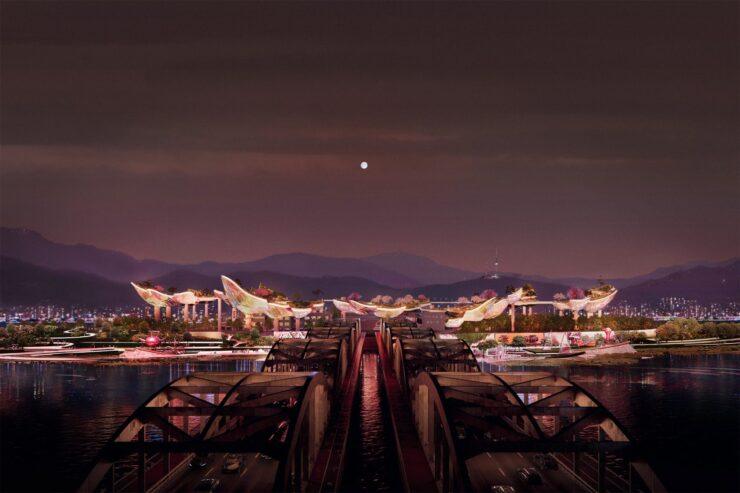
In parallel with the Biennale, Heatherwick will lead the Soundscape Project, a transformation of Nodeul Island on the Han River (previously featured on our site). This ambitious initiative merges nature, technology, and art, reimagining the island as a dynamic cultural hub that celebrates Seoul’s urban soundscape.
At the heart of the project is an interactive installation that captures and modulates sounds from the river, wind, vegetation, and human activity. Using advanced audio technology, the installation will create a multisensory experience that reshapes how visitors perceive and engage with sound in urban environments.
The island—redesigned with enhanced biodiversity and architecture inspired by sound waves and Seoul’s mountain topography—will also feature a 1.2 km suspended walkway offering panoramic views of the city and river. Scheduled for completion in 2027, the project is a model of sustainable and inclusive urban design.
The Value of Biennales: Multi-Level Impact
With over 3 million participants across its first four editions, the Seoul Biennale has established itself as a thought leader in addressing global urban challenges. But what is the value of such events, both for professionals and society at large?
For architects, urbanists, engineers, and industry professionals, biennales are vital spaces for knowledge exchange and innovation. They offer opportunities to engage with the latest trends, form international networks, and present their work to a qualified audience. As Korean architect Kim Joon states:
“The Seoul Biennale is a laboratory of ideas exploring cities’ ability to respond to ever-evolving needs.”
For society as a whole, biennales succeed in bringing urban planning debates beyond academic circles, inviting citizens to reflect on the future of their cities. The inclusive approach of the Seoul Biennale, in particular, fosters greater awareness of contemporary urban challenges and encourages public participation in shaping urban environments.
At a time marked by the urgency of the climate crisis, architecture biennales play a crucial role in promoting resilient and sustainable models of urban development.
As urbanist Richard Sennett reminds us:
“The cities we build today will shape how we live—not just now, but for generations to come. The Seoul Biennale is charting a path toward cities that are both resilient and inclusive.”
A Crossroads of Ideas for the Future
The Seoul Biennale of Architecture and Urbanism has emerged as a true crossroads of ideas and practices, aimed at building a more equitable, sustainable, and human-centered urban future. Its strength lies in gathering professionals from multiple disciplines—urbanists, architects, sociologists, philosophers—and offering a unique space for multidisciplinary and inclusive exploration.
The upcoming 2025 edition, with its focus on humane urbanism and civic participation, promises to further expand the dialogue between experts and citizens. It aims not just to address the functional aspects of urban life, but also the psychological well-being of city dwellers.
In a world increasingly urbanized and faced with unprecedented environmental and social challenges, events like the Seoul Biennale are more than showcases of innovative projects—they are true catalysts for change, shaping the way we think about, design, and live in our cities.