
On May 17, 2016, in Seoul, a 34-year-old man walked into the bathroom of Gangnam subway station and stabbed a 23-year-old stranger to death. The murderer, who was arrested, claims his act was motivated by hatred toward women, claiming he had been ignored and humiliated by them all his life. Police dispute his version, attributing the act to mental health problems rather than misogyny. The trial ends with a 30-year prison sentence.
And this was the famous straw that broke the camel’s back: the diagnosis of schizophrenia that accompanied the sentence had a significant impact on the public perception of the murder. Many, especially amongst women, felt that the diagnosis mitigated the seriousness of the act, suggesting that the violent behavior was the result of psychological problems rather than real misogynistic hatred.
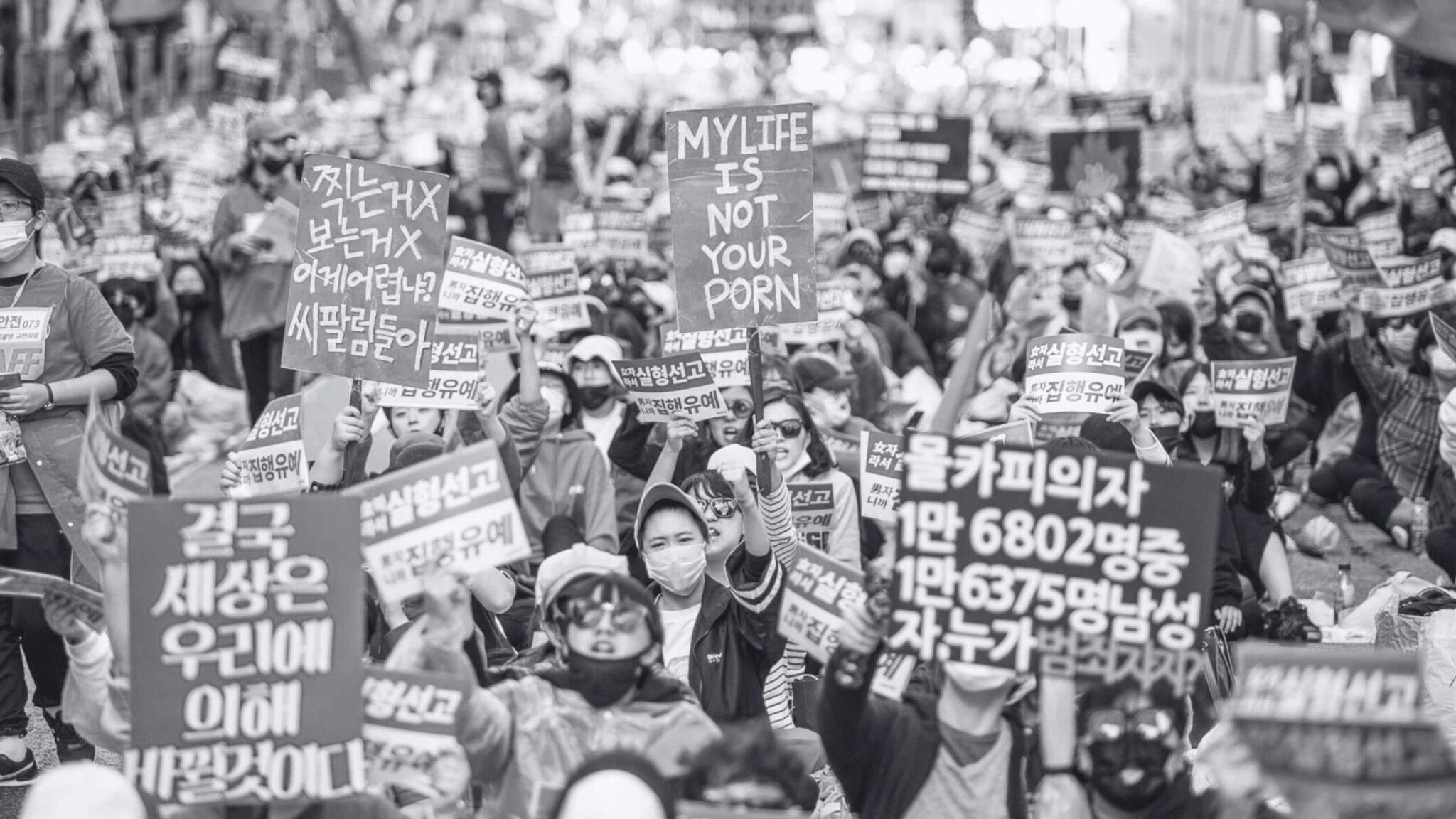
And so, along with the memorial for the victim in Gangnam Station, the 4B Movement was born and took shape .
Also known as the “Four No Movement, ” it is a radical feminist initiative based on four basic principles. The “Bi” – 비 – originates from a Chinese character that is paraphrased as “not to do/that should not be done,” and is declined into:
- Bi-hon(비혼, no to marriage)
- Bi-chulsan(비출산, no to motherhood)
- Bi-yeonae(비연애, no to dating)
- Bi-sekseu(비섹스, no to sexual relations with men).
4B has found fertile ground in a country where gender inequality is palpable. South Korean women earn about 31 percent less than their male counterparts (OECD data – 2022), and patriarchal culture is ingrained in social expectations. The movement has gained popularity through social media, especially Twitter – now X – where participants share experiences and mutual support. The lack of an official hierarchical structure has allowed the movement to remain flexible and decentralized, attracting a young and engaged audience.
4B activists do not simply reject relationships with men, but challenge tout court social norms regarding beauty and female behavior. Many women have begun boycotting cosmetic products and rejecting socially imposed beauty standards, also inspired by the “Escape the Corset” movement, which promotes authenticity and personal freedom.
Socio-cultural implications
The radical proposal to boycott men and reject heterosexual relationships has led to a profound debate about masculinity, patriarchy, and the role of women in contemporary society. 4B presents itself as a direct response to the patriarchal culture that permeates South Korean society. Women who join the movement see men as irredeemable oppressors and believe that any attempt to educate them about gender equality is futile. This rejection is not only limited to romantic relationships but also extends to everyday interactions, leading many women to minimize contact with the male gender.
Some attribute the birth rate problem to the movement: South Korea has one of the lowest birth rates in the world, and many women are choosing not to have children or marry, contributing to a population crisis that worries the government. This rejection of socially imposed reproductive expectations is seen as an act of resistance against a system that views women primarily as mothers and wives.
As is often the case with radical movements, society’s response to the 4B movement has been polarizing. While many women find inspiration in the movement’s message, men and some conservative groups see 4B as a threat to their masculinity. Political statements, such as those of President Yoon Suk-yeol (who, we recall, promised in the election campaign to eliminate the Ministry of Gender Equality and Family, only to retract as elected) who blamed feminism for the low birth rate, reflect a defensive reaction against the growing visibility of feminist demands.
4B has certainly influenced political discourse in South Korea, prompting some representatives to try to restore traditional norms and defend masculinity, such as through advocating compulsory military service, pro-birthrate policies, or even policies that incentivize women who choose to stay at home to care for their children.
Beyond Korean borders
As evidenced by the recent interest of the American press (The New Your Times, abc News, NBC News, Bloomberg to name a few), following Donald Trump’s victory the 4B movement is also finding fertile ground in the United States. Young American women are beginning to explore the principles of 4B as a response to the current and entirely likely future loss of their rights under the Trump administration. As we know, Donald Trump’s election campaign has raised concerns among women for two main reasons: the threat to reproductive rights and the growing misogyny in politics. Trump has publicly bragged about overturning Roe v. Wade, which guaranteed abortion rights, fueling fears of further restrictions on women’s reproductive health rights. In addition, the president-elect has often displayed a disparaging attitude toward women, with accusations of sexual assault and offensive behavior. Social platforms such as TikTok and Instagram have become crucial spaces for the 4B debate. Many U.S. women are sharing personal stories of frustration with men and patriarchal structures, finding inspiration in the experiences of their South Korean female peers. “No men” is becoming a mantra for some of them, taking us back to the myth of Lysistrata: faced with an ethical dilemma such as ending a war, she decided to use sexual leverage to make her point heard.
The 4B movement now represents a direct challenge to patriarchal norms in many parts of the world, from East to West. In this tumultuous socio-cultural context, 4B could become the global symbol of the struggle for gender equality, prompting more women to reflect on what it means to live uncompromisingly in a world still dominated by oppressive norms.
Read more:
- https://www.koreaherald.com/view.php?ud=20241111050610
- https://www.internazionale.it/magazine/2023/04/13/senza-i-maschi
- https://www.youtube.com/watch?v=mNj3DLQRfKA&ab_channel=AsianBoss
- https://www.independent.co.uk/life-style/4b-movement-women-celibate-sex-men-relationship-b2642967.html
- https://edition.cnn.com/2019/09/21/asia/korea-angry-young-men-intl-hnk/index.html