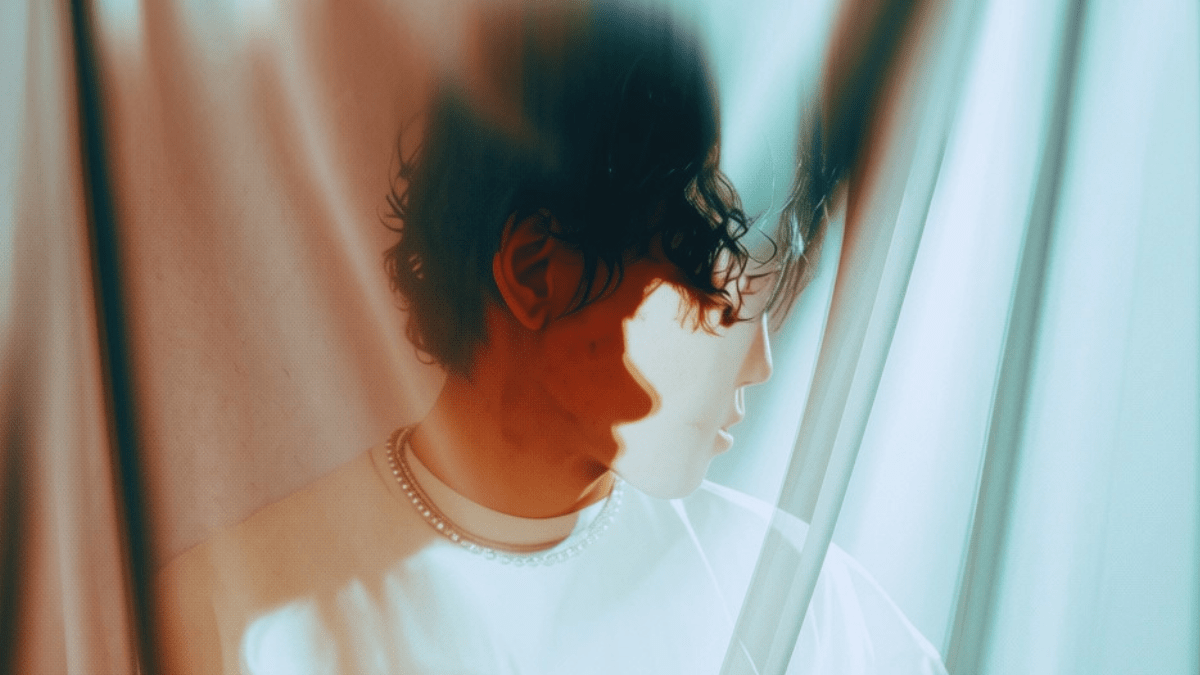

oceanfromtheblue’s answers were collected in writing by Koreami between July and August 2026. The piece departs from the traditional Q&A format: his reflections arrived in passages, and preserving them intact felt like the most honest approach.
It’s like a lighthouse—a center I can always return to by following its light, no matter how far I wander.
The Absence
To be honest, the last two or three years have been difficult. I kept asking myself whether I should continue making music, and whether I would ever be able to trust people again.
This is how Kang Juwon, a.k.a. oceanfromtheblue, begins recounting his recent years. He does so exclusively for Koreami, answering a question about the genesis of his latest project, Luv-fi 2026. For those who have followed his journey since his 2018 debut, it is a statement that carries significant weight: one of the most recognizable voices in introspective K-R&B went through a period where continuing to make music was no longer a given.
The hiatus lasted roughly two years. He stopped releasing music, though not writing it: there were numerous personal matters unfolding, he explained, and he chose to step away from the public eye. What ultimately kept him from walking away entirely was not a sudden burst of creative inspiration, but rather the listeners who kept reaching out and had not forgotten him—people to whom, he noted, he felt an urge to give something back. From that realization, Luv-fi 2026 came into focus:
“In the midst of all that, I tried to return to the mindset I had when I first started. I asked myself why I began making music in the first place, and what side of myself I wanted to share with people. The songs I worked on throughout that process naturally came together into Luv-fi 2026.”
The Trilogy
Luv-fi 2026 concludes the series where it all began. The first installment, Luv-fi (2018), arrived on March 12, 2018: ten tracks clocking in at eighteen minutes, anchored by the title track Super Mario, with the majority of the production helmed by GILLA. The second, Luv-fi 2020, landed in November 2020. The project name then remained dormant for over five years while his discography expanded in every other direction. This third chapter comprises nine tracks.
His approach, he explains, has remained consistent: every Luv-fi installment is built alongside a single producer. For this third record, he reconnected with KION, a past collaborator. Looking back at the sessions, he mentions remembering the smallest moments most vividly—sharing meals, talking about music, simply being in the studio.
The outcome is not a sonic rupture, and that was a deliberate choice: KION tracked using physical instruments without samples or virtual emulations, aiming for the warm, deliberately dated texture that, on the early Luv-fi releases, was largely a byproduct of compression. The actual shift lies elsewhere. As Juwon explained to Koreami:
The way I tell the stories inside me hasn’t changed. But my thoughts, experiences, and the things I want to express have evolved over time. If you listen to Luv-fi 2026 alongside the earlier records, you will hear a clear difference in the sound, especially in the vocals and lyrics.
In the vocals and the lyrics: that is where the core work took place. He has noted this elsewhere as well—where he previously penned intricate, highly detailed personal narratives, he pulled back on that specificity this time around, opting for melodies that are more accessible and easier to sing along to, creating music that one can inhabit rather than confront head-on. The overall texture, he noted, remains seamless with his earlier catalog.
The Name
Prior to 2018, he simply went by Ocean, and the name change stemmed from a practical issue: SoundCloud was already saturated with musicians using the moniker. The “blue” he added does not refer to the ocean, but to mood: he explained this himself, noting that in English the word also denotes melancholy, and that in his view, a person’s heart can appear bright on the surface while holding something darker within. The name, he added with a laugh, costs him at least fifteen minutes of explanation every time someone asks.
The oceanic metaphor, on the other hand, is how he describes his music: he remains the same ocean, he noted; it is the aura he projects that shifts over time—the same core person, whose music evolves through the different seasons of his life.
Born in 1993, he started out as a middle school band vocalist and kept playing into his twenties, eventually becoming the only member who did not pursue a different career path. By twenty-one, he was busking with his guitar across Hongdae and the Konkuk University area. He continued studying composition during pockets of free time throughout his mandatory military service, returning to it immediately upon discharge. He first encountered R&B during his sophomore year of high school, struck by T-Pain‘s use of Auto-Tune; Chris Brown followed, whom he cites as a foundational influence.
In 2016, he began uploading his earliest tracks to SoundCloud (you can find his profile [here]) while still performing as Ocean. The YouTube channel We Love K-pop, which scouted K-indie directly from the platform, reposted two of his songs—Baby and Wish—and from that moment, international listeners found him before the domestic Korean audience did. No television appearances, no marketing campaigns: his initial international footprint emerged two full years before his official debut.
One particular anecdote captures the essence of those early years better than any metric. A couple in their thirties wrote to tell him they had navigated a marriage crisis and avoided divorce while listening to Super Mario, the title track of the first Luv-fi. He noted that the story left a lasting impression: realizing that a song could carry real weight in someone else’s life motivated him to dedicate himself even more deeply to his craft.
When Another Voice Is Needed
Guest features across his discography are sparing, yet deliberate. Speaking to Koreami, he outlined the strict criteria behind his selections—from Close to You with sunwoojunga to Jason Lee’s saxophone contributions on ordinary love:
I only reach out to another artist for a feature when I truly feel it’s essential. Some artists feature guests on almost every track and rarely release music entirely on their own. For me, there’s a stronger urge to tell my own stories through my own voice. Yet there are moments when I can clearly hear another artist’s voice on a specific part of a song. I always try to fill that space myself first, and if I still sense something is missing, that’s when I extend the invitation. I think that’s why those collaborations end up coming together so seamlessly.
It is a more uncompromising stance than it might seem in a landscape where guest features frequently serve as algorithmic leverage: here, a collaborator enters the room only after the solo attempt proves insufficient. This philosophy aligns closely with another insight he shared—that he lacks the disposition to fabricate stories he hasn’t lived, and that he exercises rigorous self-editing, repeatedly asking himself before finalizing a lyric whether he will genuinely be able to deliver it on stage.
Later in 2023 came the mixtape NEWRNBERA—read as “New RnB Era”—a record centered on rediscovering the genre’s foundational roots alongside veteran figures of the Korean hip-hop scene like Paloalto and The Quiett. Regarding the title, however, he was quick to offer a grounded clarification: he does not view himself as the catalyst of that new era, noting that he would simply like to be present when it arrives.
The Lighthouse
Released on February 2, 2023, his self-titled full-length oceanfromtheblue remains the central pillar of his discography—built using an approach that is the exact opposite of the Luv-fi installments: twelve tracks assembled through a songwriting camp involving ten different producers, alongside vocal contributions from Yeeun (formerly of CLC), sunwoojunga, and Kuhyun. He explained the rationale at the time: working alone, he kept hitting creative ceilings and wanted to push beyond them, which required considerable time and a broader collaborative circle. It was an idea he had been turning over for years—as early as late 2019, he had mentioned wanting to eventually transition toward a collective song camp format.
That album became another vital pillar of my work alongside the Luv-fi series. It’s like a lighthouse—a center I can always return to by following its light, no matter how far I wander. (…) Because it’s a self-titled record, I consider it the album that represents me most honestly. Having that foundation is also what gives me the freedom to boldly explore different genres and styles.
“The album that represents me most honestly,” he notes—and the track where this becomes clearest is Brother, dedicated to his younger brother with autism. He had attempted to write it multiple times over the preceding years without success. Perhaps, he reflected upon the album’s release, reaching his thirties is what finally allowed him to articulate those emotions with the right balance, without overstatement.
The Stage
Since 2022, Juwon has centered his live performances around a five-piece band: himself on vocals, joined by bass, guitar, drums, and keyboards. The lo-fi atmosphere of the records translates on stage into a distinct neo-soul energy. The 2023 European tour Way to Blue spanned fourteen cities—including Madrid, Zurich, London, and the intimate, stand-out Milan date at Santeria Toscana 31 (trust me, I was there)—solidifying the staying power of his music before international crowds.
In 2024 came the live recording of 25 for the global platform COLORSxSTUDIOS, a single-take vocal performance captured completely live.
Freedom
The conversation with Koreami also turned to what artistic maturity means to him today, eight years into his career:
The question made me think deeply about what freedom truly means. I believe it’s a very challenging concept. The freedom I experienced in the past and the freedom I hold now are different, and each carries its own sense of discomfort and anxiety. (…) I think I will remain an artist who keeps pushing forward within that constant tension, capturing that struggle and expressing it through music.
The Future
The trilogy comes to a close, but the creative output does not: following the release, he announced a rollout of singles for the remainder of the year, a new full-length record taking a completely different sonic direction from Luv-fi 2026, and an Asian tour kicking off in Bangkok on September 5, with the hope of returning to Europe soon. What remains open-ended is something else entirely:
I don’t have concrete plans just yet, but Luv-fi has always been a project I know I can return to one day when the time feels right. If I focus on what’s directly in front of me without rushing, I’m confident I’ll naturally find myself working on the next installment. (…) Until then, I hope everyone continues to spend time with Luv-fi 2026. To craft a new chapter that feels both familiar and entirely fresh, I’ll keep gathering new experiences and collecting inspiration along the way.
And that is precisely the point: the trilogy concludes, but the series remains alive. Luv-fi 2026 is neither a grandiose comeback statement nor an abrupt reinvention—it is the work of an artist who, after spending two years wondering if making music was still worth the effort, answered by returning to the starting line to see if something was still there. It was. The lighthouse remains unchanged, the light feels warmer, and the true creative statement—in a genre that often prioritizes immediate recognizability—was choosing to sit with that unresolved tension rather than force a resolution. He had put it into words years ago, describing his work as the coexistence of joy and sadness: even in his brightest tracks, he explained, he seeks to surface the underlying melancholy, estimating that about thirty percent of his listeners catch it. And I most definitely count myself among that thirty percent.
Exclusive interview by Elisa Gambino for Koreami.
Post correlati
-
 We interviewed Dane, our (and your) new crush.
-
 An R&B soul, an inspiration as sweet as gelato, and a passport that dreams of Italy: our interview with Riaan.
-
 Beyond OSTs. Elaine Kim on Creative Urgency | Interview
-
 EL CAPITXN: to start a new life, the previous one must end | Interview
-
 Changing the k‑pop alphabet — Big Ocean and communication as performance | Interview
-
 Colde is back! Here’s what he told us about his new EP, ICY BABY.