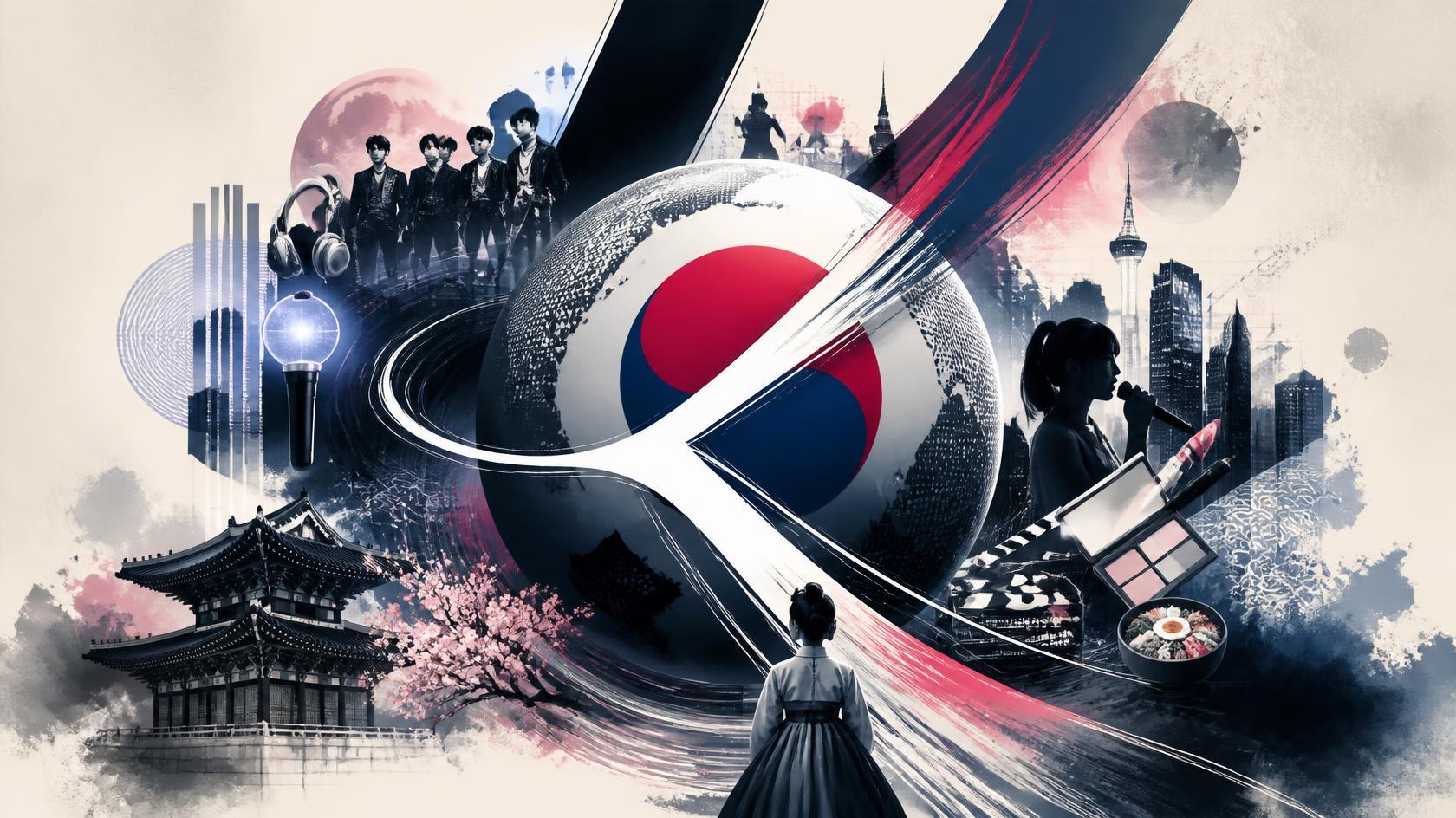

Electric-blue neon bathing the streets of Seoul; an aesthetic café in Hannam-dong where the afternoon light hits a chiffon cake just right; an idol’s face caught in an ending fairy, complete with a millimeter-calibrated smile. For millions around the world, this montage is “Korea”—a headspace where modernity, beauty, and everyday life seem to flow with zero friction.
What we consume as Hallyu does not mirror real-life Korea. Instead, it is a space of co-creation, where industry and global audiences collectively build an imaginary. And that is precisely where the real question emerges: what are we actually looking at when we look at “Korea for export”?
Mirror and Billboard
The distinction proposed by David A. Tizzard between Korea as a “mirror” and K-culture as a “billboard” (here) is useful because it cuts straight through this asymmetry. The mirror reflects the country’s domestic conversation: historical trauma, social friction, workplace hierarchies, protests, demographic aging. It is an opaque, layered dimension, often hard to decipher from the outside.
Right now, even as K-dramas dominate global charts, tens of thousands of Hyundai workers in Seoul are striking over wages and automation. Just a few weeks ago, 10,000 union demonstrators took to the streets to defend subcontracted workers’ rights. This is the Korea of the mirror: forged in struggles, conflicts, and grassroots organizing. You won’t spot it in an idol’s ending fairy.
The billboard, by contrast, is the export-ready version of Koreanness: a curated blend of aesthetics, music, and storytelling engineered for instant global appeal. It doesn’t show everything, nor does it pretend to. It showcases what can travel, seduce, achieve recognition, and be consumed.
A Contemporary Myth
This is where the concept of myth comes in. In the Barthesian sense—the way semiotician Roland Barthes framed modern myths—a myth is a narrative that distills complex reality into a crisp, emotional, reassuring image. The flawless choreography, the romantic drama, the immaculate idol are not factual fabrications. They are storytelling vehicles that curate, condense, and render a specific vision of Korean modernity legible.
That very condensation is what generates the allure. K-culture works because it doesn’t ask us to grasp the whole picture: it offers high-intensity, aesthetically self-contained fragments designed to be loved even without mastering their native context. Yet every myth leaves something out. And what gets left behind is often the most uncomfortable, contentious, and unresolved facet of the society it represents.
The Audience Isn’t Passive
The real story, however, isn’t just what the industry puts on screen. It’s what the audience does with what it receives.
When fandom translates lyrics, dissects comebacks, reconstructs cultural nuance, pens fanfiction, spins breakdown threads, coordinates streaming parties, or rallies charity drives, it ceases to be a mere consumer. It becomes part of the engine. K-culture, in this sense, is not just a product consumed from afar: it is an ecosystem decoded, reshaped, and turbocharged by the very people following it.
The idea that audiences actively produce meaning rather than just passively receiving it has been a cornerstone of cultural studies for decades—from Jenkins’s “participatory culture” and Fiske’s “active audience” to Appadurai’s global cultural flows and their “indigenization.” But with K-culture, the dynamic shifts. We aren’t simply looking at communities appropriating media built for Western consumers; we are looking at a creative industry designed from day one for a global audience, paired with a public that plugs directly into its production and success machine: real-time translators, uncredited promoters, streaming tacticians, charity organizers. Their labor is not a bonus—it is the very engine of the phenomenon.
Audience participation cannot be treated as a side note. It is a foundational pillar of K-culture’s global momentum. Fandom drives its visibility, longevity, and both its symbolic and commercial equity. Far from being a byproduct of the system, it is its core infrastructure.
Co-creation and Pressure
This co-creation, however, carries a darker side. The raw energy of fandom can easily slide into toxic rivalry, obsession, and nonstop surveillance metrics. Streaming drives, community turf wars, the obsession with charts, and the so-called “streaming illusion” reveal how the genuine desire to back an artist can warp into an unrelenting grind demanding constant performance, raw numbers, and viral reach around the clock.
At that stage, the original spark—the song, the drama, the artist—risks fading into the background, eclipsed by community policing and performance metrics: how much you stream, how hard you promote, how much you drive the brand’s valuation.
This same dynamic feeds back into how the artists’ public personas are crafted. Flawless looks, military discipline, effortless grace, and hyper-controlled mannerisms fuel K-culture’s mystique, but they also forge an impossibly high standard. The myth that lands abroad inevitably boomerangs back, applying immense pressure to the very society that engineered it.
A Necessary Boundary
Consuming Korea through its pop culture is not the same as understanding Korean society. Social codes, unwritten hierarchies, generational rifts, and unspoken tensions remain opaque even to the most dedicated consumers.
Yet this distinction doesn’t devalue the international audience’s connection; in my opinion, it elevates it. Our relationship with K-culture is authentic, yet partial; passionate, yet far from exhaustive. We inhabit an imaginary that moves us, thrills us, and occasionally mobilizes us. But that gives us no license to mistake it for the full reality of contemporary Korea.
Common Ground
Perhaps the most accurate way to frame this is to see K-culture as a shared terrain. On one side stands the Korean culture industry, crafting content tailored for global reach and fine-tuning it to travel and perform. On the other stands an international audience receiving, interpreting, amplifying, and translating it into tangible social practice.
In between lies a space of relentless negotiation: likes, comment threads, amateur translations, community forums, fan edits, streaming drives, fundraisers, and endless discourse. It is inside this friction that K-culture emerges as a shared global vernacular.
It is by no means an equal exchange. The billboard always has an owner, an agenda, a budget, and clear economic and political stakes. Meanwhile, the mirror endures elsewhere, rooted in the layered complexity of a society that exported pop culture can never fully capture.
Engaging Without Possessing
Acknowledging this asymmetry does not mean stripping away the joy of K-culture. It means engaging with it more intelligently. What we love is a curated frame, not the whole canvas; a striking image, not the full truth; an encounter, not a replacement for reality.
The next time we hit play, we can do so with sharper eyes. We are neither passive observers nor omnipotent co-creators. We are participants in a collaborative cultural space: the industry supplies the raw material, but the audience provides the velocity, the collective memory, and the emotional weight.
And that might just be the most compelling facet of global Korea: not that it reveals the “real Korea,” but that it shows us how a transnational imaginary is forged today. At the crossroads of aesthetics, desire, consumption, and interpretation, K-culture has become an arena where the world actively shapes the symbolic transformation of a nation.
Post correlati
-
 BTS WORLD TOUR ‘ARIRANG’: quando la moda costruisce la scena
-
 Less than a Lover (Jennie): Testo e Traduzione
-
 Il primo Daesang dei CORTIS
-
 Ju Haknyeon (ex THE BOYZ) vince in tribunale contro One Hundred Label: respinta la causa da 8 miliardi di won
-
 Effetto BTS: HYBE vola nel secondo trimestre 2026
-
 RM (BTS) si racconta a Fashion Neurosis: leadership, arte e identità