
In the din of a digital landscape saturated with loud vlogs and raucous challenges, discovering the Seoul Drive YouTube channel felt like opening a window onto a suspended, silent, and beautiful dimension. As a true connoisseur of channels exploring the myriad facets of the Korean capital, I often spend my evenings seeking out those cherished panoramas I long to revisit. It was during one of these nocturnal wanderings that I stumbled, almost by chance, upon these videos.
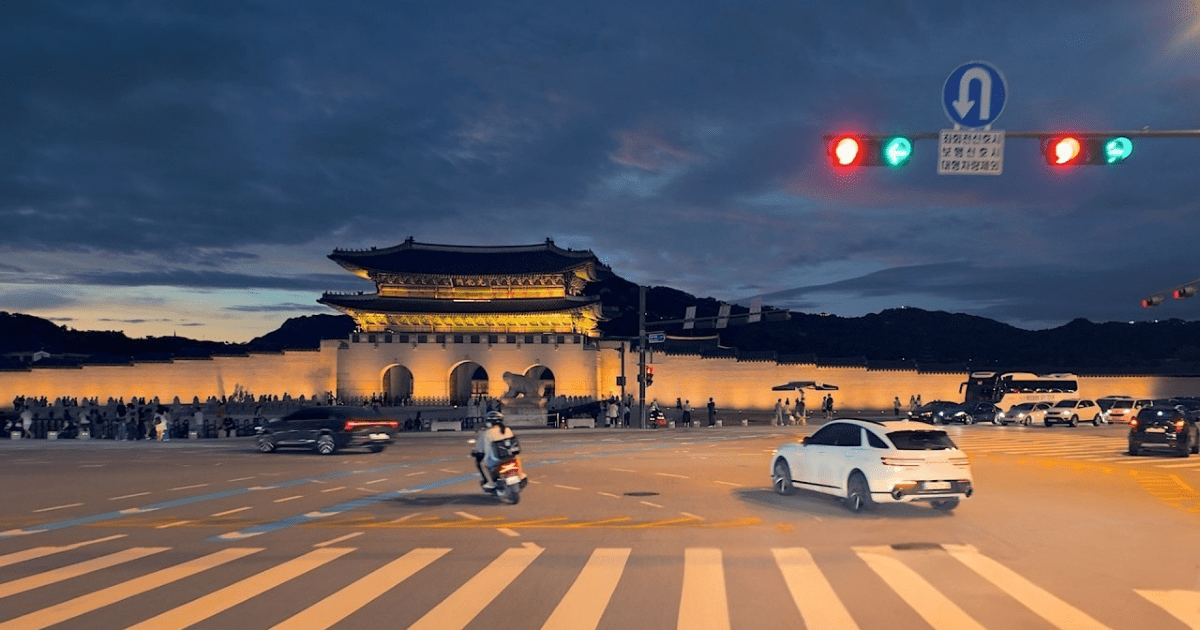
On the screen, there was only the road unfurling directly before my eyes. It felt like sitting in the driver’s seat, immersed in the night of Seoul. No commentary, no face, no filters. Just the pure sound of the city blending with music capable of instantly dissolving all tension. It was not merely a matter of technically impeccable visuals; what struck me was the immediate conveyance of a specific therapeutic sensation—a form of digital healing as powerful as it was unexpected.
My curiosity took over. I wondered: who is behind that wheel? Does this all stem from a personal need? So, I followed my instinct. Acting on impulse, I wrote an email to the creator—driven by that slightly reckless enthusiasm that defines me—to inquire about the project’s genesis.
The responses I received during our email exchange confirmed my every intuition. The filmmaker—whose absolute anonymity I respect, having no knowledge of their gender or age—explained that the project exists to capture the “quiet hour“: those moments when the city, frantic by day, begins to breathe only after dark. And the most fascinating revelation concerns the sound: s/he compose all the music independently, strictly “from memory” days after the drive, to relive those moments and fill with notes the emotional voids that the camera alone cannot capture.
Over time, our dialogue evolved into a proposal to offer a space that would treat this work not as “disposable” content, but as the art form that it truly is. This is also why, in addition to this interview, you will now find direct access to the channel’s videos on the Koreami homepage.
Here is our conversation on how to transform traffic… into mindfulness.
Inside Seoul Drive’s mind
Many people see driving in traffic as stressful. You, however, turn it into an act of “presence.” Is there an exact moment, a mental “click,” when the commute stops being a simple trip and becomes a mindfulness experience? And what do you think allows that “click” to happen?
When I focus entirely on the present—on what I see, hear, and sense—the drive naturally becomes a moment of immersion. I think driving becomes stressful when we let it carry our emotions or amplify them. But if we treat it as a step toward presence rather than an outlet, the experience shifts completely.
Your car seems to be more than just a vehicle: it’s a mobile studio, a protective cocoon, an observation point. What is your relationship with the physical space of the car’s interior while you’re immersed in the city? Is it a space that isolates you to allow for better observation, or an instrument that connects you more deeply with the outside?
To me, the car is both a boundary and a window. It’s enclosed, yet open at the same time—a small stage from which I meet the city. When I drive through Seoul and look out the window, the city feels like an enormous film set, and I’m one small part of that scene.
Is there a route in Seoul —perhaps a specific bridge, a tunnel, or a tree-lined avenue—that holds a special emotional meaning for you, a place you go not to get somewhere, but simply for the pleasure of “being” in that flow?
I’ve always felt drawn to the bridges over the Han River. Jamsu Bridge and Dongho Bridge, especially, evoke something unique in me. Jamsu Bridge welcomes both cars and pedestrians, but it’s ultimately built for walking—its gentle slopes, the gloss of the river, the wind. It naturally brings back memories. Dongho Bridge offers a very different kind of emotion. When you cross from Apgujeong toward the north at night, the dense clusters of apartment lights resemble starlight—or even a traditional Korean folding screen stretching across the hill.
In our past conversation via e-mail, you described Seoul at night as a city that “breathes” and becomes “more honest”. If you could describe the “breath” of different neighborhoods—for example, the fast, vibrant breath of Gangnam versus the slower, more historic one of Samcheong-dong—what sounds and rhythms would you associate with each?
Gangnam breathes fast and sharp, almost like EDM—vertical skylines, hard lines, constant movement. Samcheong-dong and Hyehwa feel more like classical music, with softer rhythms and low, horizontal scenery. Hongdae and Yeonhui-dong have the spontaneity of jazz; unpredictable elements repeat and transform. Yeouido is a stable bassline—steady, controlled, repetitive.
Water, whether it’s the rain on the asphalt or the slow-flowing Han River, is a recurring element in your aesthetic. What role does water play in your emotional perception of Seoul? Does it amplify melancholy, purify it, or simply reflect its lights in a way that makes it more magical?
Water is an emotional mirror. The wide, slow Han River carries a deep calm, while its surface reflects Seoul’s lights like glimmers of the city’s own gaze. In those reflections, our own reality and emotions quietly appear as well.
Beyond the lights and movement, what are the almost imperceptible smells or sensations of nocturnal Seoul that you try to capture, which perhaps only someone who is truly “present” can grasp? The cold air coming through the window, the smell of rain on warm asphalt, the scent of a late-night street food stall?
The scent of Seoul’s night air through a half-open window, the breeze along the Han River, the sudden traces of perfume or food near Apgujeong Rodeo, the layered aromas of late-night markets in Nonhyeon— These are sensations unfamiliar to those who haven’t lived here, yet everyone has their own local equivalent. My intention is to evoke those personal memories in the viewers, letting them imagine their own version of Seoul as they watch.
The fact that you compose every single music track adds incredible depth to the project. What prompted you to also become the “sound designer” of your experiences, in addition to being the director? Is there something that only your music can express about those drives?
As Seoul’s rhythm passes through “my” filter, certain empty spaces appear—moments that can’t be completed by commercial music. I needed music that flowed gently like the visuals, and at times broke off abruptly. That slight imperfection felt essential to the world of Seoul Drive, so I chose to create the tracks myself.
Could you guide us a little more through that journey? When you sit down to compose, days after the drive, what are the tools—both musical and emotional—that you use to transform a memory, a feeling, into a melody?
Vivid memories are usually dominated by visuals, not sound. So I wait. I let the sensations of the drive soften and settle. When they become quieter and more internalized, I begin composing from that distilled memory. Even though my videos appear documentary in form, I want them to be created through Seoul Drive’s own senses and perspective. Composing from memory is what allows that.
Are they born together, or are they two separate creations that meet at the end? Does the music serve to describe the video, or does the video serve to give a face to the music you already had inside you after that drive?
Usually, the video comes first. But eventually, the two complete each other. If the visuals represent the face of Seoul as I experienced it, the music is the heartbeat I felt beneath it. When they meet, the emotional reality of the city comes alive and is fully conveyed to the audience.
Your work fits perfectly into the Korean culture of “healing” (힐링), which encourages finding harmony within reality, not by escaping it. Is this an intentional message for your audience? An invitation to find beauty and calm not in spite of modern life, but through it?
Yes. Seoul Drive began as a personal form of healing. I wanted to share the realization that harmony can be found within reality—not by escaping it. Even inside a vast, complex organism like Seoul, stillness exists. Showing that was important to me, and it became the heart of the project.
If you had to distill the entire philosophy of “Seoul Drive” into a single feeling you hope to convey to those who watch your videos, what would it be? Comfort, nostalgia, peace, or perhaps the simple awareness that even in an ordinary moment, something sacred can be found?
A quiet kind of comfort. I want to highlight the subtle warmth hidden in the moments we pass by without noticing. Seoul Drive is a record of the emotions—both living and still—that fill the vast organism of Seoul.
Post correlati
-
 Eyes On: Junhee – The CEO’s Bet and the (Re)birth of an Artist
-
 Interview | Light and Shadow: Dept Opens Up, “I’m more playful than my music suggests”
-
 Beyond OSTs. Elaine Kim on Creative Urgency | Interview
-
 Koreami Trend Alert #1: K-Perfume, the New Frontier of Wellness.
-
 Oulalalala (Orelsan e FIFTY FIFTY): Lyrics and Italian Translation [Exclusive]
-
 Tachyonic Leap: The Frontier Filmmaking of Jang Theo.